
Commercial Leasing in Scotland
Commercial leasing in Kirkcaldy, Fife and across Scotland involves significant legal and commercial considerations for both landlords and tenants. Whether you are letting business premises for the first time, taking on a new retail unit, or negotiating a lease renewal, Fords Daly Legal provides clear, practical advice to help you protect your interests and enter into arrangements that support your long-term business objectives under Scots law.
A commercial lease is often one of the most significant legal commitments a business will make. Unlike residential tenancies, commercial leases in Scotland are largely unregulated, meaning the terms you agree to will govern your rights and obligations for many years. The rent you pay, your repairing responsibilities, restrictions on how you can use the premises, and your options for ending the lease early all depend on what is negotiated and documented at the outset.
At Fords Daly Legal, we advise landlords, tenants and investors across Kirkcaldy, Glenrothes, Dunfermline, Leven and throughout Fife on all aspects of commercial leasing. We explain lease terms in plain English, identify potential risks before you commit, and help ensure the final agreement reflects your commercial priorities. Our goal is to give you the confidence to proceed knowing exactly what you are agreeing to.
Quick Navigation

Understanding Commercial Leases
Commercial leases differ significantly from residential tenancies. There is no equivalent of the Private Housing (Tenancies) (Scotland) Act 2016 protecting commercial tenants, which means the terms you negotiate and agree are the terms you will live with for the duration of the lease. This makes professional legal advice essential before signing.
Key issues that arise in commercial leases typically include:
- Lease length and security of tenure – How long the lease runs for and whether you have any right to remain at the end
- Rent and rent review provisions – The initial rent, when it can be reviewed, and how increases are calculated
- Repairing obligations – Who is responsible for maintaining the property, including structural repairs and interior upkeep
- Service charges – Additional costs for common areas, insurance, and building management in multi-let properties
- Permitted use – Restrictions on what business activities can be carried out from the premises
- Alienation provisions – Your ability to assign the lease to someone else or sublet part of the premises
- Break clauses – Options to end the lease early and the conditions attached to exercising them
Understanding these terms before you commit is essential, as they can affect your flexibility, costs, and business operations for many years. Our role is to ensure you fully understand what you are agreeing to and how it may affect you in practice.
What Our Commercial Leasing Service Includes
When you instruct Fords Daly Legal to advise on a commercial lease, we provide comprehensive legal support tailored to your position, whether you are the landlord or the tenant. Our service covers every stage of the leasing process:
- Reviewing and advising on heads of terms – We help you understand proposed commercial terms before legal drafting begins, ensuring the deal makes sense for your business
- Drafting commercial leases – For landlords, we prepare comprehensive lease documents that protect your property and rental income
- Reviewing and negotiating lease terms – For tenants, we analyse proposed leases, explain the implications of each clause, and negotiate amendments to protect your interests
- Advising on repairing obligations – We explain what you are committing to and help negotiate terms that are fair and proportionate
- Lease variations and renewals – We assist with changing existing lease terms and negotiating lease extensions
- Assignations and subletting – We advise on transferring leases to new tenants or subletting part of your premises
- Liaising with lenders – Where bank consent is required for lease arrangements, we handle the necessary communications
- Lease termination advice – We guide you through ending a lease, whether by break clause, expiry, or negotiated surrender
Throughout the process, we keep you informed in plain English, ensuring you understand each step and can make informed decisions about your commercial property arrangements.
Acting for Landlords
If you are letting commercial premises, your priorities typically include securing reliable rental income, protecting the condition of your property, and maintaining control over how the premises are used. A well-drafted lease is essential to achieving these goals.
When acting for landlords, we focus on:
- Comprehensive repairing obligations – Ensuring the tenant takes responsibility for keeping the property in good condition
- Clear rent review mechanisms – Including provisions that allow rent to be reviewed upwards in line with market conditions
- Appropriate use restrictions – Limiting the tenant to uses that protect the property and neighbouring businesses
- Controlled alienation – Ensuring you have approval rights over any assignment or subletting
- Strong enforcement provisions – Clear remedies if the tenant breaches the lease terms
We understand that commercial property is often a significant investment, and we work to ensure your lease documentation protects that investment effectively.

Acting for Tenants
If you are taking on a commercial lease, your concerns are likely to be different. You may be focused on keeping costs manageable, maintaining flexibility as your business evolves, and ensuring you can exit the lease if circumstances change.
When acting for tenants, we pay particular attention to:
- Repairing liability – Negotiating fair and proportionate obligations, particularly for older properties
- Schedules of condition – Documenting the property’s current state to limit your responsibility for pre-existing issues
- Rent review caps – Seeking limits on how much rent can increase at review
- Break clauses – Negotiating options to end the lease early if your business needs change
- Permitted use flexibility – Ensuring you can adapt the premises as your business develops
- Service charge transparency – Understanding and limiting exposure to unpredictable additional costs
We recognise that signing a commercial lease is a significant commitment for any business, and we work to ensure the terms are fair and workable for your situation.

Common Commercial Leasing Situations
Commercial leasing needs arise in many different contexts. Some of the common situations where clients seek our advice include:
New Business Premises
Whether you are a start-up taking on your first retail unit, an established company expanding to new offices, or a restaurant securing premises in a busy location, we help you understand the lease terms and negotiate a deal that works for your business.
Property Investment
If you are purchasing or developing commercial property for investment, we advise on drafting leases that protect your income stream and maintain property value. We also review existing leases when you are buying tenanted property.
Lease Renewals and Extensions
When an existing lease is approaching expiry, we advise on negotiating new terms or extensions. This is often an opportunity to address issues that have arisen during the current lease or to secure more favourable conditions.
Business Sales and Transfers
If you are selling a business that includes leased premises, or buying one, we advise on assigning the lease to the new owner and ensuring all parties understand their obligations.
Subletting Arrangements
If you have surplus space or need to share premises, we advise on subletting arrangements, ensuring you comply with your head lease obligations and protect your position.
Timeline: How Long Does Commercial Leasing Take?
The time required to complete a commercial lease depends on the complexity of the transaction and how quickly both parties can agree terms. A straightforward lease with agreed heads of terms might complete in 4-8 weeks, while more complex negotiations can take longer.
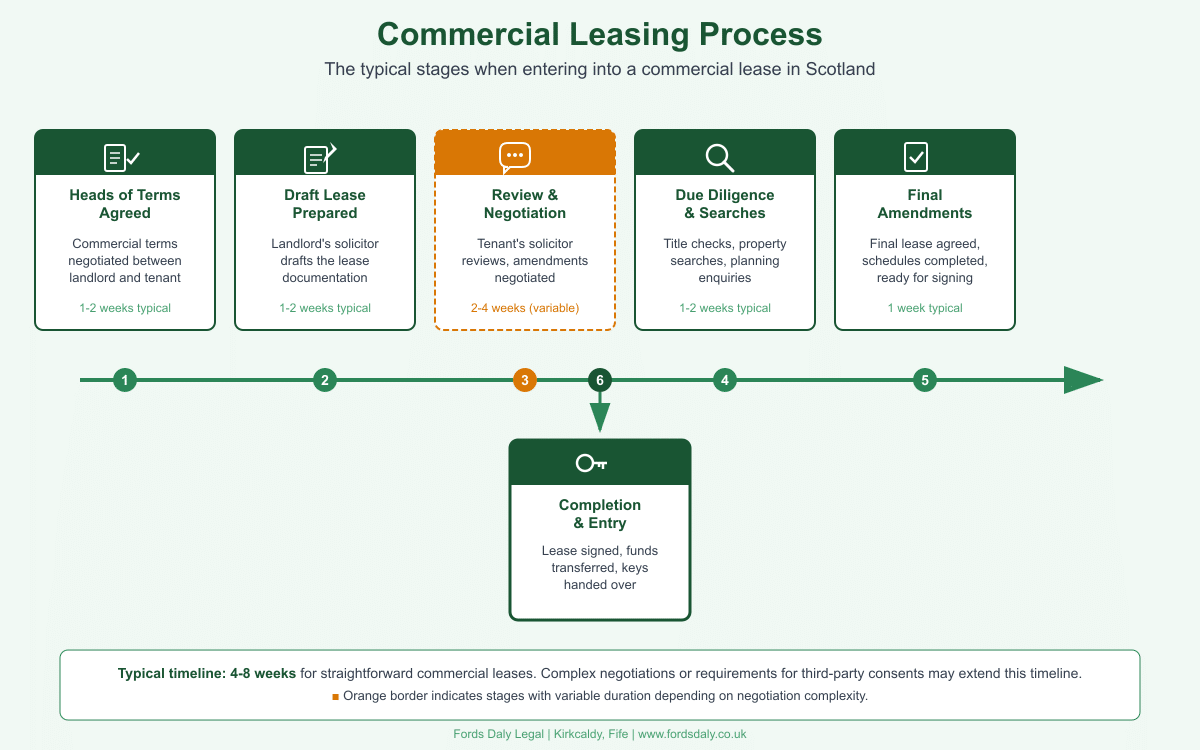
Factors that can affect timing include:
- The complexity of the lease terms being negotiated
- Whether a schedule of condition needs to be prepared
- Requirements for landlord or lender consents
- The responsiveness of the other party and their solicitors
- Any planning or licensing requirements
We keep you informed throughout the process and work efficiently to avoid unnecessary delays while ensuring nothing is overlooked.

Why Choose Fords Daly Legal
Clients across Kirkcaldy, Glenrothes, Dunfermline, Leven and throughout Fife choose Fords Daly Legal for commercial leasing because we combine legal expertise with genuine commercial awareness.
- Strong experience in Scottish commercial leasing – We understand the specific legal framework that applies to commercial property in Scotland
- Plain-English explanations – We translate complex lease terms into clear, practical advice you can act on
- Local market knowledge – We understand the commercial property market in Kirkcaldy, Fife and surrounding areas
- Practical, business-focused approach – We focus on achieving workable outcomes, not just technical legal positions
- Proactive risk identification – We highlight potential issues before they become problems
- Regulated by the Law Society of Scotland – Our professional standards and client account protections give you peace of mind
Our aim is to help you enter into commercial leasing arrangements with confidence, knowing exactly what you are committing to and how to protect your business interests.
Take the Next Step
If you are dealing with a commercial lease in Scotland—whether you are a landlord in Kirkcaldy letting premises for the first time, a tenant in Fife negotiating a new lease, or an investor looking at commercial property anywhere in Scotland—Fords Daly Legal is here to help. Our experienced team provides clear, practical advice to help you achieve the best possible outcome.
📞 Call us on 01592 265055 to speak with our commercial property team
✉️ Email us to arrange a consultation
🏢 Visit usat our Kirkcaldy office for a face-to-face meeting
Getting advice early in the commercial leasing process helps ensure you enter into arrangements that truly support your business objectives. Contact us today to discuss your commercial leasing needs.

Frequently Asked Questions About Commercial Leasing in Scotland
Do I need a solicitor to enter into a commercial lease?
While it is not a legal requirement to have a solicitor, professional legal advice is strongly recommended. Commercial leases are complex documents with long-term implications, and the terms you agree to will govern your rights and obligations for many years. A solicitor can identify potential problems, explain what you are committing to, and negotiate better terms on your behalf. The cost of legal advice is usually modest compared to the financial exposure a poorly negotiated lease can create.
Can the terms of a commercial lease be negotiated?
Yes, most commercial lease terms are negotiable. Even when a landlord presents what appears to be a standard lease, there is usually scope to negotiate key provisions such as rent review mechanisms, repairing obligations, break clauses, and permitted use. The extent of what can be negotiated depends on factors like market conditions, the desirability of the property, and the relative bargaining power of the parties. Having experienced legal advice helps you identify what is negotiable and what amendments are worth pursuing.
How long do commercial leases usually last?
Commercial lease lengths in Scotland vary widely depending on the type of property and the preferences of the parties. Retail premises might have leases of 5-15 years, while office leases often range from 3-10 years. Industrial properties may have longer terms. Shorter leases are increasingly common, particularly for smaller tenants who want flexibility. The lease length affects other terms like rent review frequency and break options, so it is important to consider the overall package when negotiating.
What are repairing obligations and why are they important?
Repairing obligations determine who is responsible for maintaining and repairing the property during the lease. A ‘full repairing and insuring’ (FRI) lease places all repair responsibility on the tenant, including structural repairs and roof maintenance. This can be extremely expensive, particularly for older properties. Tenants should consider negotiating limitations on repairing obligations or obtaining a schedule of condition that documents the property’s existing state, limiting their liability to maintaining that condition.
Can a commercial lease be ended early?
Whether you can end a lease early depends on its terms. Many leases include ‘break clauses’ that allow either or both parties to terminate at specified points, but these usually come with strict conditions—such as giving notice in a particular form and by a specific date, or ensuring all rent is paid and there are no outstanding breaches. If there is no break clause, ending a lease early typically requires the landlord’s agreement and may involve paying compensation.
What is a schedule of condition?
A schedule of condition is a detailed record (usually photographic and written) of the property’s condition at the start of a lease. It is particularly important for tenants because it can limit your repairing obligations to maintaining the property in the condition recorded—meaning you are not responsible for defects or deterioration that existed before you took the lease. Preparing a thorough schedule of condition is strongly recommended, especially for older or previously occupied premises.
Can I assign my lease to someone else?
Your ability to assign (transfer) a lease depends on the alienation provisions in your lease. Most leases allow assignment but require the landlord’s consent, which typically cannot be unreasonably withheld. The landlord may impose conditions, such as requiring the incoming tenant to demonstrate financial standing or requiring you to guarantee the new tenant’s obligations. Some leases contain more restrictive provisions or prohibit assignment altogether. Understanding these terms is important if you may need to transfer the lease in future.
What are service charges in a commercial lease?
Service charges are additional payments tenants make towards the cost of services provided by the landlord, typically in multi-let buildings. These can include cleaning common areas, security, building insurance, lift maintenance, and contributions to a sinking fund for major repairs. Service charges can be significant and unpredictable, so it is important to understand what is included, how charges are calculated, and whether there are any caps on increases. Reviewing historic service charge accounts before signing is advisable.
How do rent reviews work in commercial leases?
Rent reviews are periodic assessments that allow the rent to be adjusted during the lease. Common mechanisms include ‘open market’ reviews (where rent is set at the current market rate for similar premises), ‘upward only’ reviews (where rent can only increase, never decrease), and indexed reviews (linked to inflation measures like CPI). The review frequency – typically every 3-5 years – and the mechanism used can significantly impact your long-term costs. Tenants should understand these provisions and negotiate where possible.
What happens at the end of a commercial lease?
Normally, you would expect a commercial lease to end on the termination date. However, in Scotland, there is a principle of tacit relocation. This means that unless either the landlord or tenant gives the other notice of termination, complying with the notice provisions contained in the lease, the lease will continue for a further year on the terms that prevailed on the original termination date. Thereafter, the lease will continue on a year to year basis until either the landlord or tenant issues a termination notice.
What is 'permitted use' in a commercial lease?
Permitted use clauses restrict what business activities you can carry out from the leased premises. A narrowly drafted clause might limit you to a very specific use (such as ‘retail sale of clothing’), while a broader clause might allow general retail or office use. If your business changes or you want to diversify, a restrictive permitted use clause could prevent this without the landlord’s consent. Tenants should ensure the permitted use is broad enough to accommodate potential future changes to their business.
How much does commercial leasing advice cost?
Legal fees for commercial leasing depend on the complexity of the transaction, the value of the lease, and the extent of negotiation required. We provide clear fee information at the outset so you know what to expect. For straightforward leases with agreed terms, fees are typically predictable. For more complex negotiations or high-value transactions, costs may be higher but are usually proportionate to the financial commitment involved. Contact us for a fee estimate based on your specific situation.
Related Services
Depending on your commercial property needs, you may also find the following services helpful:
- Commercial Purchase – Legal advice on buying commercial property in Scotland
- Commercial Sale – Support with selling commercial premises and completing transactions
- Commercial Re-financing – Assistance with re-mortgaging or changing lenders on commercial property
- Business Sales and Acquisitions – Legal support when buying or selling a business, including premises
- Residential Conveyancing – If you also have residential property needs, our residential team can help