
Financial Provision on Divorce in Scotland
Financial provision on divorce in Kirkcaldy, Fife and across Scotland determines how finances and property are divided when a marriage comes to an end. At Fords Daly Legal, we provide clear, practical advice to help you understand your rights, protect your financial position, and achieve a fair outcome under Scots law.
When a marriage breaks down, resolving financial matters is often one of the most challenging aspects of divorce. Questions about the family home, savings, pensions, and ongoing support can feel overwhelming, particularly during an already difficult time. Understanding your legal rights and options is the first step towards achieving clarity and security.
Fords Daly Legal advises clients throughout Fife—including Kirkcaldy, Glenrothes, Dunfermline, and Leven—on all aspects of financial provision on divorce. We explain the law in plain English, guide you through the process step by step, and work towards a fair and workable financial settlement that allows you to move forward with confidence.
Quick Navigation
On this page:
- What Is Financial Provision on Divorce?
- What Counts as Matrimonial Property?
- What Can Be Included in a Financial Settlement
- How Financial Provision Is Calculated
- Reaching a Financial Settlement
- The Family Home
- Pensions and Divorce
- Timeline: How Long Does It Take?
- Why Choose Fords Daly Legal
- Frequently Asked Questions

What Is Financial Provision on Divorce?
Financial provision refers to the financial arrangements made between spouses when they divorce. In Scotland, the law focuses on achieving a fair sharing of what is known as ‘matrimonial property’—assets acquired during the marriage that are subject to division.
Unlike some other jurisdictions, Scottish law takes a structured approach based on defined legal principles set out in the Family Law (Scotland) Act 1985. The starting point is generally equal sharing, but the court has discretion to depart from this where circumstances make it appropriate.
Understanding how financial provision works is essential to protecting your interests and achieving a settlement that reflects your contributions and needs. Whether you are the higher earner or financially dependent spouse, clear legal advice ensures you approach negotiations from an informed position.
What Counts as Matrimonial Property?
Matrimonial property in Scotland generally includes all assets acquired by either spouse during the marriage and before the ‘relevant date’—typically the date of separation. This applies regardless of whose name the asset is held in.
Common examples of matrimonial property include:
- The family home (if purchased during the marriage)
- Other properties acquired during the marriage
- Savings accounts and investments
- Pension rights built up during the marriage
- Business interests or shares
- Vehicles, furniture, and other possessions
- Joint debts and liabilities
Certain assets are generally excluded from matrimonial property, including gifts or inheritances received by one spouse (unless converted into matrimonial use), and property owned before the marriage. However, the family home can be treated differently and may be subject to division even if owned before the marriage in some circumstances.
What Can Be Included in a Financial Settlement
A financial settlement can address a wide range of matters to ensure both parties can move forward with financial security. The settlement typically covers:
Capital Payments
One spouse may pay the other a lump sum to balance out the division of assets. This is common where one party is retaining the family home or other significant assets.
Property Transfer
Ownership of property, including the family home, may be transferred from one spouse to the other as part of the settlement.
Pension Sharing
The matrimonial portion of pension rights can be shared through a Pension Sharing Order, giving each spouse their own independent pension provision.

Periodical Allowance
In some cases, ongoing financial support may be appropriate for a limited period. This is typically awarded where one spouse needs time to adjust financially—for example, to retrain for employment or care for young children.
Incidental Orders
The court can make various incidental orders, such as requiring the sale of property, valuation of assets, or ordering disclosure of financial information.

How Financial Provision Is Calculated
The Family Law (Scotland) Act 1985 sets out five principles that guide how financial provision should be determined. These principles help ensure that settlements are fair and take account of the specific circumstances of each case.
The Five Principles
1. Fair sharing of matrimonial property – The net value of matrimonial property should be shared fairly, which is presumed to be equal unless there are special circumstances.
2. Economic advantage and disadvantage – Fair account should be taken of any economic advantages derived by either party from contributions by the other, and of any economic disadvantages suffered by either party in the interests of the family.
3. Sharing the economic burden of childcare – The economic burden of caring for children under 16 should be shared fairly between the parties.
4. Financial dependence adjustment – A spouse who has been financially dependent should receive support for a reasonable period to enable adjustment.
5. Relieving serious financial hardship – An order may be justified to relieve a party of serious financial hardship caused by the divorce.
In practice, the first principle – fair sharing of matrimonial property – is most commonly applied. The court will identify all matrimonial property, determine its value, and then decide how it should be divided.
Reaching a Financial Settlement
Many financial settlements are reached through negotiation rather than court proceedings. This approach is generally quicker, less expensive, and allows both parties greater control over the outcome.
Negotiation
Your solicitor can negotiate directly with your spouse’s solicitor to reach an agreement. This involves exchanging financial information, identifying areas of agreement and disagreement, and working towards a mutually acceptable solution.
Mediation
Mediation involves an independent third party helping you and your spouse reach agreement. It can be particularly useful where communication has broken down or emotions are running high.
Collaborative Practice
In collaborative divorce, both parties and their solicitors commit to resolving matters without going to court. If agreement cannot be reached, the solicitors must withdraw, providing a strong incentive to find solutions.
Court Proceedings
Where agreement cannot be reached, court action may be necessary. Financial provision claims can be made within divorce proceedings, and the court will make a determination based on the evidence and legal principles. We can advise you on the best approach for your circumstances and represent your interests throughout the process.
Urgent Situations
In cases involving domestic abuse or urgent concerns about children or finances, we can advise on emergency protective measures including interdicts, exclusion orders, and interim orders. Your safety and that of your children is always the priority.
The Family Home
The family home is often the most significant asset—and the most emotive issue—in divorce proceedings. Decisions about the home can have long-lasting implications for both parties.
There are several options for dealing with the family home:
- Sell the property and divide the proceeds
- One spouse buys out the other’s share
- Transfer ownership to one spouse with offsetting arrangements elsewhere in the settlement
- Retain joint ownership for a period—for example, until children finish school
The best approach depends on various factors including mortgage arrangements, equity in the property, the needs of any children, and whether either party can afford to retain the home. We help you understand your options and the practical and legal implications of each.
Pensions and Divorce
Pensions are often the second most valuable asset after the family home, yet they are frequently overlooked or undervalued. Proper consideration of pension rights is essential for a fair settlement.
The matrimonial portion of a pension – the value built up during the marriage – forms part of matrimonial property. There are several ways to deal with pensions in divorce:
Pension Sharing Order
A portion of one spouse’s pension is transferred to the other, who then has their own independent pension rights. This provides a clean break.
Offsetting
One spouse retains their pension while the other receives a larger share of other assets, such as the family home, to compensate.
Pension Attachment (Earmarking)
A portion of pension benefits are paid to the former spouse when the pension comes into payment. This does not provide a clean break and is less commonly used.
Obtaining accurate pension valuations is important, and specialist actuarial advice may be needed for complex pension arrangements. We can advise on the best approach for your circumstances.
Timeline: How Long Does Financial Provision Take?
The time required to resolve financial provision varies significantly depending on the complexity of assets, whether agreement can be reached, and whether court proceedings are necessary.
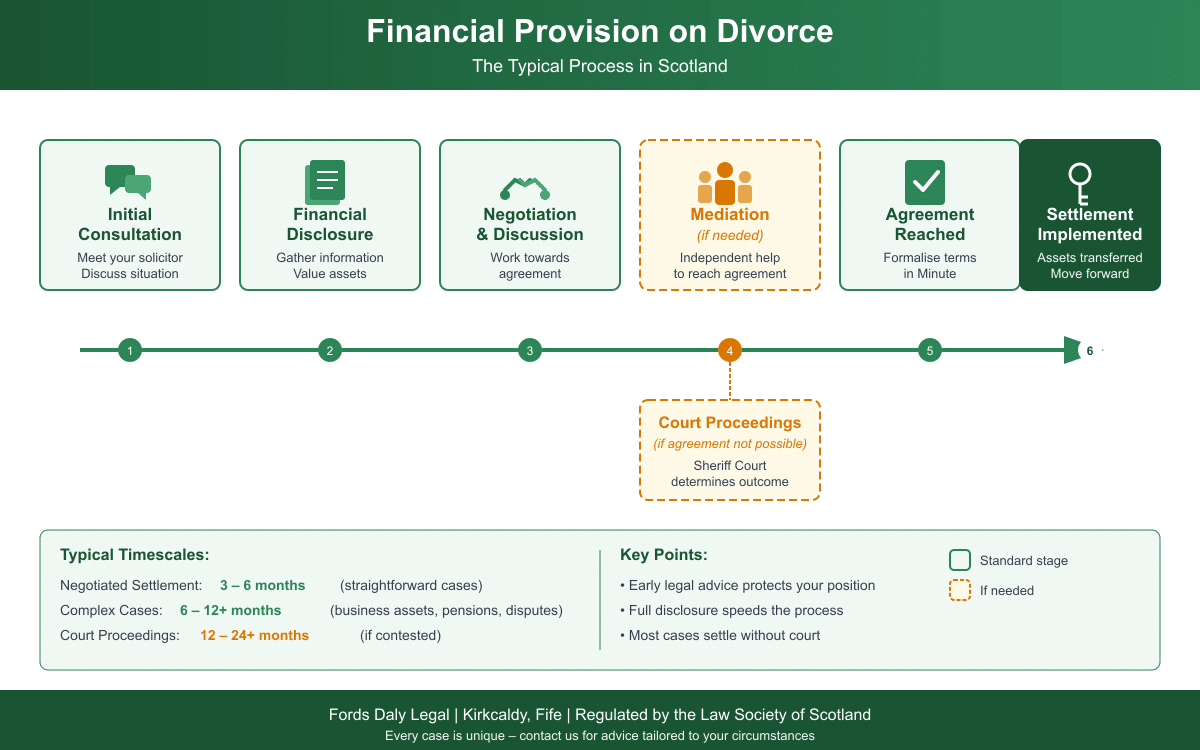
For straightforward cases where parties can reach agreement, financial provision can often be resolved within 3-6 months. More complex cases involving significant assets, business valuations, or disputed matters may take 12 months or longer. Court proceedings can extend timescales considerably.
Early engagement with the process, prompt disclosure of financial information, and a willingness to negotiate constructively can all help achieve a quicker resolution.

Why Choose Fords Daly Legal
Clients across Kirkcaldy, Glenrothes, Dunfermline, Leven, and throughout Fife choose Fords Daly Legal for financial provision on divorce because of our client-focused, practical approach.
- Clear, plain-English advice – We explain the law and your options without unnecessary jargon, so you understand your position and can make informed decisions
- Strong understanding of Scots family and property law – Our team has extensive experience in financial provision matters and stays current with legal developments
- Proactive, solutions-focused approach – We work to achieve fair, realistic, and achievable outcomes while protecting your interests
- Local service, local knowledge – Based in Kirkcaldy, we serve clients throughout Fife and understand the local property market and court procedures
- Regulated by the Law Society of Scotland – Providing assurance of professional standards and client protection
- Competitive, transparent fees – We discuss costs openly from the outset so you can plan accordingly
Our aim is to help you move forward with financial clarity and security, achieving a settlement that is fair and allows you to begin the next chapter of your life.
Take the Next Step
If you are facing financial provision on divorce in Scotland, whether in Kirkcaldy, Fife, or the surrounding areas, Fords Daly Legal is here to help. Our experienced family law team will listen to your concerns, explain your options clearly, and guide you towards a fair resolution.
📞 Call us on 01592 640630 to discuss your situation
✉️ Email us with your enquiry and we’ll respond promptly
🏢 Visit our Kirkcaldy office, conveniently located for clients across Fife
The sooner you seek advice, the better positioned you will be to protect your financial interests. Contact Fords Daly Legal today to arrange an initial consultation.

Frequently Asked Questions About Financial Provision on Divorce in Scotland
What is matrimonial property in Scotland?
Matrimonial property generally includes all assets acquired by either spouse during the marriage and before the date of separation. This can include the family home (if purchased during the marriage), savings, investments, pensions, vehicles, and business interests. Certain assets are typically excluded, including gifts or inheritances received by one spouse (unless converted to joint use) and property owned before the marriage. However, the rules can be complex, and exceptions may apply, particularly regarding the family home.
Is everything split 50/50 on divorce in Scotland?
The starting point under Scots law is that matrimonial property should be shared fairly, and fair sharing is presumed to be equal. However, the court can depart from equal sharing where there are ‘special circumstances.’ These might include an agreement between the parties, the source of particular assets, or the destruction or dissipation of property by one spouse. Each case is assessed on its own facts, and there is no automatic assumption that everything will be divided equally.
Are pensions included in financial provision on divorce?
Yes. Pensions are often one of the most valuable assets in a marriage and the matrimonial portion – the value built up during the marriage – forms part of matrimonial property. Pensions can be dealt with through pension sharing orders (transferring a portion to the other spouse), offsetting (retaining the pension in exchange for other assets), or pension attachment. Accurate valuation of pension rights is important, and specialist advice may be needed for defined benefit schemes or complex arrangements.
Do I have to go to court to resolve financial matters?
Not necessarily. Many couples reach agreement on financial matters through negotiation between solicitors, mediation, or collaborative practice, without the need for contested court proceedings. However, court action may be necessary where agreement cannot be reached, where one party is not engaging properly with the process, or where there are complex or disputed assets. Even in court proceedings, settlement is often reached before a final hearing.
What is the 'relevant date' for financial provision?
The relevant date is typically the date the parties ceased to cohabit (i.e., the date of separation). This date is significant because matrimonial property is valued as at this date. Assets acquired after the relevant date, and changes in asset values after this date, may be treated differently. Determining the relevant date can sometimes be contentious, particularly where parties continued to live under the same roof but the marriage had effectively ended.
Can I claim ongoing maintenance (aliment) from my spouse?
Scots law generally favours a ‘clean break’ principle, meaning financial matters are resolved at the time of divorce rather than through ongoing payments. However, a periodical allowance may be awarded for a limited period where one spouse needs time to adjust financially, for example, to retrain for employment, complete education, or care for young children. Ongoing periodical allowance after divorce is relatively uncommon and typically time-limited.
What happens to the family home on divorce?
The family home is often the most significant asset to be addressed. Options include selling the property and dividing the proceeds, one spouse buying out the other’s share, transferring ownership to one spouse with balancing payments elsewhere in the settlement, or retaining joint ownership for a defined period. The best approach depends on factors including mortgage arrangements, available equity, the needs of any children, and whether either party can afford to retain the home independently.
How are business interests treated in divorce?
Business interests acquired or built up during the marriage generally form part of matrimonial property. Valuing a business can be complex and may require expert forensic accountancy evidence. The court will consider factors such as when the business was started, how it was funded, and the extent to which each spouse contributed. Options for dealing with business interests include valuation and offsetting, buyout arrangements, or in some cases, ongoing involvement.
What if my spouse is hiding assets?
Both parties have an obligation to provide full and frank disclosure of their financial circumstances. If you believe your spouse is hiding assets or not being truthful about their finances, the court can make orders requiring disclosure, including production of bank statements, tax returns, and other financial documents. In serious cases, forensic accountancy investigations may be appropriate. Failure to disclose assets can have serious consequences and may result in any agreement being set aside.
When should financial matters be resolved?
Financial provision claims should ideally be resolved at the same time as the divorce. If you obtain a divorce without addressing financial matters, you may lose the right to make certain claims—particularly capital claims. It is important to seek legal advice early so that your rights are protected and financial matters can be dealt with alongside the divorce process.
Can a prenuptial agreement affect financial provision?
Prenuptial agreements (also called prenups or ante-nuptial agreements) can be taken into account by the court when determining financial provision, though they are not automatically binding. The court will consider whether the agreement was entered into freely, whether both parties had independent legal advice, whether there was full financial disclosure, and whether the terms are fair and reasonable in the circumstances. A well-drafted prenuptial agreement can be influential in determining the outcome.
How much does financial provision advice cost?
Costs depend on the complexity of your case, the value of assets involved, whether agreement can be reached, and whether court proceedings are necessary. We discuss costs openly from the outset and can provide estimates based on your circumstances. In straightforward cases resolved by negotiation, costs will be considerably lower than in contested court proceedings. We always aim to provide cost-effective advice and keep matters proportionate to what is at stake.
Related Services
You may also find the following services helpful:
- Separation and Divorce – Guidance on the divorce process in Scotland, including simplified and defended procedures
- Separation Agreements – Formal agreements to regulate arrangements when couples separate
- Cohabitation Rights – Understanding your rights and options if you are an unmarried couple
- Child Arrangements – Resolving matters relating to children’s residence and contact
- Conveyancing – Assistance with property transactions arising from divorce settlements