
Separation Agreements in Scotland
Separation agreements in Kirkcaldy, Fife and across Scotland provide a clear and legally binding way for separating couples to record financial and practical arrangements. At Fords Daly Legal, we offer practical, straightforward advice to help you reach a fair agreement and move forward with certainty under Scots law.
When a relationship breaks down, many couples want to resolve matters without unnecessary conflict or court proceedings. A separation agreement can provide clarity and stability by setting out what has been agreed between you and your former partner, covering finances, property, and other practical matters.
Fords Daly Legal advises individuals throughout Fife, including Kirkcaldy, Glenrothes, Dunfermline, and Leven, on separation agreements. We explain the process in plain English, protect your interests, and help you reach arrangements that are fair, workable, and legally effective.
Quick Navigation
On this page:

What Is a Separation Agreement
A separation agreement is a legally binding contract between two people who have decided to separate. It records the agreed arrangements relating to finances, property, and other practical matters that need to be resolved when a relationship ends.
Unlike a divorce, which is a court process that formally ends a marriage, a separation agreement is a private contract between the parties. It does not require court approval and can be entered into whether or not you are married, in a civil partnership, or cohabiting.
Once properly prepared and signed by both parties, a separation agreement becomes legally enforceable. This means that if one party fails to comply with its terms, the other can take legal action to enforce the agreement. A well-drafted separation agreement provides certainty, reduces the risk of future disputes, and allows both parties to move forward with confidence.
Benefits of a Separation Agreement
There are many reasons why separating couples choose to enter into a separation agreement rather than leaving matters unresolved or proceeding directly to court:
Certainty and Clarity
A separation agreement sets out clearly what has been agreed, so both parties know exactly where they stand. This avoids misunderstandings and provides a reference point if questions arise later.
Avoiding Court Proceedings
Many couples prefer to resolve matters privately rather than through contested court proceedings. A separation agreement allows you to reach a solution on your own terms, without the stress, expense, and uncertainty of litigation.
Flexibility
A separation agreement can be tailored to your specific circumstances. You and your former partner can agree arrangements that work for both of you, rather than having terms imposed by a court.
Cost-Effective
Negotiating a separation agreement is generally much less expensive than contested court proceedings. While both parties should take independent legal advice, the overall cost is typically far lower than litigation.
Privacy
Court proceedings become part of the public record, whereas a separation agreement is a private document between the parties. This can be particularly important where there are concerns about confidentiality.
What Can a Separation Agreement Cover?
A separation agreement can deal with a wide range of issues, depending on your individual circumstances. Common matters addressed include:
The Family Home
Arrangements for the family home, whether it will be sold, transferred to one party, or retained jointly for a period, are often central to a separation agreement.
Division of Assets
The agreement can set out how savings, investments, vehicles, and other assets will be divided between the parties.
Debts and Liabilities
Responsibility for joint debts, mortgages, loans, and other liabilities can be addressed, making clear who will be responsible for what going forward.

Pensions
Pension rights built up during the relationship can be included in a separation agreement, whether through pension sharing, offsetting, or other arrangements.
Ongoing Financial Support
Where appropriate, the agreement can provide for ongoing financial payments from one party to the other, either for a fixed period or until certain conditions are met.
Other Practical Matters
A separation agreement can also address other practical issues such as household contents, personal belongings, and any other matters the parties wish to resolve.

Separation Agreements and Divorce
A separation agreement can be entered into whether or not divorce proceedings have begun, and serves different purposes depending on your circumstances:
Before Divorce
Many couples use a separation agreement to regulate matters during the period of separation, with divorce to follow later. This is particularly common where the parties need to wait for the required period of separation before they can divorce, but want certainty about financial and practical arrangements in the meantime.
Alongside Divorce
A separation agreement can be prepared at the same time as divorce proceedings, setting out the agreed financial arrangements that will take effect when the divorce is finalised.
Instead of Court Proceedings
For couples who can reach agreement, a separation agreement can settle all financial matters without the need for contested court proceedings. A properly drafted agreement will generally be taken into account by the court if divorce proceedings later take place, providing assurance that your agreed arrangements will be respected.
It is important to understand that a separation agreement does not itself end a marriage—only divorce can do that. However, it can resolve the financial and practical matters that often accompany divorce.
Reaching Agreement Fairly
For a separation agreement to be effective and enforceable, it must be entered into fairly, with both parties understanding what they are agreeing to and the implications of the agreement.
Full Financial Disclosure
Both parties should have a clear and complete picture of the financial position before entering into an agreement. This includes disclosure of assets, debts, income, and any other relevant financial information. Without full disclosure, an agreement may be vulnerable to challenge.
Independent Legal Advice
Each party should have their own solicitor who can explain the agreement, advise on whether the terms are fair and reasonable, and ensure they understand the legal consequences of what they are signing. This protects both parties and strengthens the agreement.
No Undue Pressure
An agreement should be entered into voluntarily, without pressure or coercion. Both parties should have adequate time to consider the terms and take advice before signing.
Our aim is to help you reach an agreement that is fair to both parties and provides long-term certainty and peace of mind.
The Separation Agreement Process
The process of putting a separation agreement in place typically involves several key stages:
1. Initial Consultation
We meet with you to understand your situation, explain the process, and discuss what you hope to achieve. We advise on your legal position and the options available to you.
2. Financial Disclosure
Both parties exchange information about their financial circumstances, including assets, debts, income, and pensions. This ensures that any agreement is based on a full and accurate picture.
3. Negotiation
Your solicitor negotiates with your former partner’s solicitor to reach agreement on the terms. We keep you informed throughout and advise on any proposals received.
4. Drafting the Agreement
Once terms are agreed, we prepare a formal written agreement that accurately reflects what has been agreed and is legally effective under Scots law.
5. Review and Signing
Both parties review the final agreement with their solicitors, who explain the terms and confirm understanding. The agreement is then signed by both parties, making it legally binding.
6. Implementation
The agreed arrangements are put into effect—property transfers, financial payments, or other steps are completed as set out in the agreement.
Timeline: How Long Does a Separation Agreement Take?
The time required to put a separation agreement in place varies depending on the complexity of your circumstances and how quickly agreement can be reached.
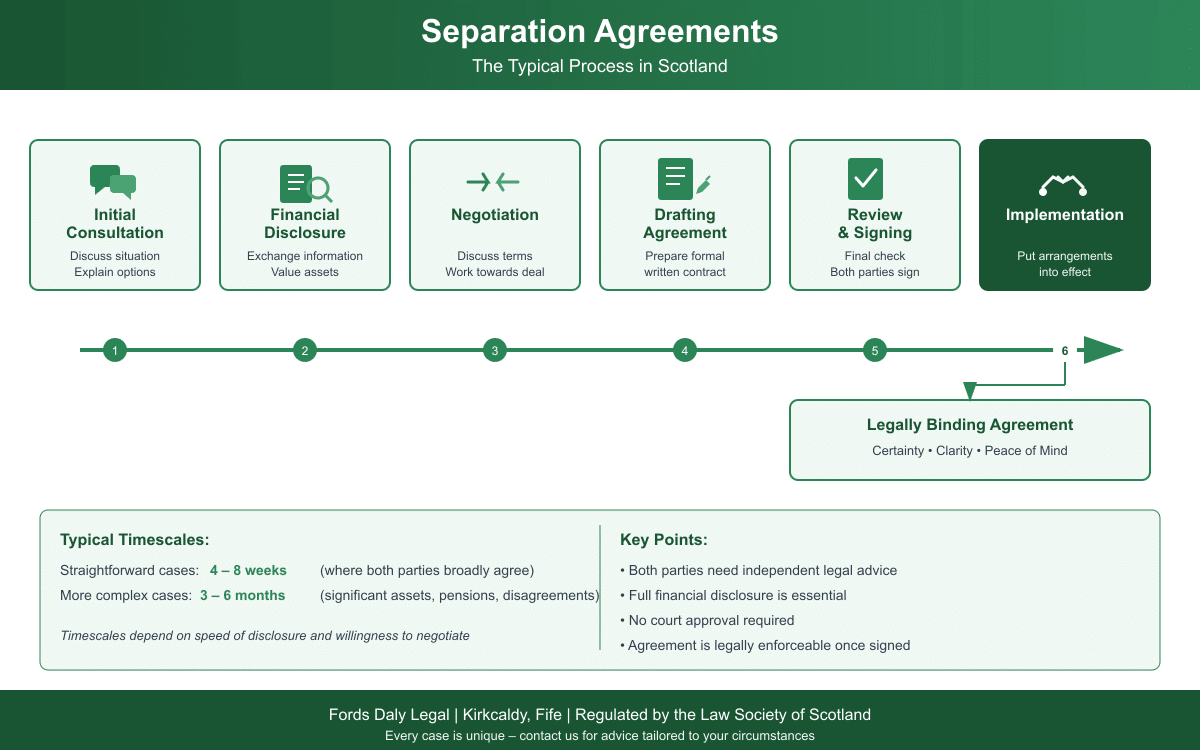
For straightforward cases where both parties are broadly in agreement, a separation agreement can often be completed within 4-8 weeks. More complex cases—involving significant assets, pensions, or areas of disagreement—may take 3-6 months or longer.
Key factors affecting timescales include the speed of financial disclosure, the complexity of assets to be divided, and how quickly the parties can reach agreement on terms. Prompt engagement with the process and a willingness to negotiate constructively can significantly reduce the time required.

Why Choose Fords Daly Legal
Clients across Kirkcaldy, Glenrothes, Dunfermline, Leven, and throughout Fife choose Fords Daly Legal for separation agreements because of our calm, practical, and client-focused approach.
- Clear, plain-English advice – We explain the process and your options without unnecessary jargon, so you understand your position and can make informed decisions
- Strong understanding of Scots family and contract law – Our team has extensive experience in separation agreements and stays current with legal developments
- Focus on negotiated, workable outcomes – We aim to help you reach agreement without unnecessary conflict or expense
- Sensitive, supportive service – We understand that separation is a difficult time and provide advice with empathy and discretion
- Local service, local knowledge – Based in Kirkcaldy, we serve clients throughout Fife
- Regulated by the Law Society of Scotland – Providing assurance of professional standards and client protection
Our aim is to help you move forward with clarity and confidence, reaching an agreement that is fair and provides certainty for the future.
Take the Next Step
If you are considering a separation agreement in Scotland, whether in Kirkcaldy, Fife, or the surrounding areas, Fords Daly Legal is here to help. Our experienced family law team will listen to your concerns, explain your options clearly, and guide you towards a fair and workable agreement.
📞 Call us: Contact our Kirkcaldy office to discuss your situation
✉️ Email us: Send your enquiry and we’ll respond promptly
🏢 Visit us: Our Kirkcaldy office is conveniently located for clients across Fife
The sooner you seek advice, the sooner you can achieve certainty and move forward. Contact Fords Daly Legal today to arrange an initial consultation.

Frequently Asked Questions About Separation Agreements in Scotland
Is a separation agreement legally binding in Scotland?
Yes. A properly drafted and signed separation agreement is legally binding under Scots law. This means that if one party fails to comply with its terms, the other party can take legal action to enforce the agreement. For this reason, it is important that the agreement is carefully prepared and that both parties understand what they are signing.
Do we both need our own solicitors?
Yes, each party should take independent legal advice from their own solicitor. This ensures that both parties fully understand the agreement and its implications, that the terms are fair, and that neither party can later claim they did not understand what they were signing. Having independent advice also strengthens the agreement and makes it more difficult to challenge.
Can a separation agreement be changed later?
Once signed, a separation agreement is legally binding and can be difficult to change. It may be varied if both parties agree to the changes and formalise them in a new agreement. In limited circumstances, an agreement may be challenged in court, for example, if there was misrepresentation, duress, or a failure to disclose material information. However, such challenges are not easy to succeed with, which is why it is important to get the terms right from the outset.
Do we need to go to court to have a separation agreement approved?
No. Separation agreements are private contracts between the parties and do not require court approval to be legally binding. This is one of the advantages of a separation agreement—it allows you to resolve matters without the need for court proceedings. However, if divorce proceedings later take place, the court will usually take the agreement into account when considering financial provision.
Can a separation agreement cover pensions?
Yes. Pensions can be included as part of a separation agreement. The agreement can provide for pension sharing, offsetting (where one party retains their pension in exchange for a larger share of other assets), or other arrangements. Because pensions are often valuable and complex assets, legal advice is essential when dealing with pension provision in a separation agreement.
What is the difference between a separation agreement and a divorce?
A separation agreement is a private contract that records the financial and practical arrangements between separating parties. It does not end the marriage. Divorce is a court process that formally ends a marriage. A separation agreement can be entered into before, during, or instead of divorce proceedings, and can settle the financial matters that often accompany divorce, but only divorce itself can end the marriage.
Will a separation agreement be upheld if we later divorce?
A properly drafted separation agreement will generally be given significant weight by the court in any subsequent divorce proceedings. The court will consider whether the agreement was entered into fairly, with full disclosure and independent advice. If these conditions are met, the court will usually uphold the agreed terms. This provides reassurance that your agreement will be respected.
Can unmarried couples have a separation agreement?
Yes. Separation agreements are not limited to married couples. Cohabiting couples who are separating can also enter into a separation agreement to record how they will divide assets, deal with property, and handle other practical matters. This can be particularly important for cohabitants, as they have more limited automatic rights under Scots law than married couples.
How much does a separation agreement cost?
Costs depend on the complexity of your circumstances and how quickly agreement can be reached. For straightforward cases, costs are typically modest compared to contested court proceedings. We discuss costs openly from the outset and can provide an estimate based on your situation. Both parties will have their own legal costs, as each should take independent advice.
What happens if my partner won't agree to the terms I want?
A separation agreement requires both parties to agree. If you cannot reach agreement through negotiation, other options may be available, such as mediation or, ultimately, court proceedings. However, many couples find that with skilled negotiation and independent advice, agreement can be reached even where there are initial disagreements. We work to find solutions that both parties can accept.
How long does a separation agreement last?
A separation agreement remains in force until its terms have been fully implemented, or until the parties agree to vary or replace it. Some provisions may have ongoing effect (such as arrangements for financial support), while others may be completed shortly after signing (such as property transfers). The agreement should be drafted to make clear how long each provision applies.
What if circumstances change after the agreement is signed?
If circumstances change significantly after a separation agreement is signed, the parties can agree to vary the terms by entering into a new agreement. However, one party cannot unilaterally change the agreement simply because their circumstances have changed. This is why it is important to consider future possibilities when drafting the original agreement and to take legal advice on appropriate provisions.
Related Services
You may also find the following services helpful:
- Separation and Divorce – Guidance on the divorce process in Scotland, including simplified and defended procedures
- Financial Provision on Divorce – Advice on the division of assets, pensions, and financial settlements
- Conveyancing – Assistance with property transfers arising from separation agreements
- Making a Will – Updating your Will following separation to reflect changed circumstances