
Separation and Divorce in Scotland
Facing separation or divorce in Kirkcaldy, Fife or the surrounding areas can be one of life’s most difficult experiences. At Fords Daly Legal, we provide clear, practical family law advice to help you understand your options, protect your interests, and move forward with confidence under Scots law.
The breakdown of a relationship is rarely straightforward, particularly when finances, property, or children are involved. Whether you’re considering separation, ready to begin divorce proceedings, or simply need to understand where you stand legally, it’s important to get the right advice early. Making informed decisions now can save considerable time, stress, and expense later.
Our family law team advises individuals across Kirkcaldy, Glenrothes, Dunfermline, Leven, and throughout Fife on all aspects of separation and divorce. We take a calm, supportive, and practical approach—explaining the legal process in plain English and helping you understand your options at every stage. Whether you’re hoping for an amicable resolution or need robust representation to protect your position, we’re here to help.
Quick Navigation

Understanding Separation in Scotland
Separation occurs when married couples decide to live apart, whether or not divorce proceedings have begun. In Scotland, separation is an important legal concept because it often forms the basis for establishing that a marriage has irretrievably broken down.
Some couples separate informally with no written agreement, while others choose to formalise their arrangements through a separation agreement. A formal separation agreement can address important matters such as division of assets, living arrangements, financial support, and arrangements for children. While separation doesn’t automatically end your marriage, it can be a valuable step towards resolving matters and, where appropriate, progressing towards divorce.
We can advise you on the legal implications of separation and help you understand what steps may be appropriate in your particular circumstances. For some couples, a period of separation provides time to reflect and consider the future. For others, it’s a necessary first step on the path to divorce.
Grounds for Divorce in Scotland
In Scotland, there is only one ground for divorce: the irretrievable breakdown of the marriage. However, this can be established in several different ways:
One Year's Separation with Consent
If you and your spouse have lived apart for at least one year and you both consent to the divorce, this is often the most straightforward route. Both parties must agree that the marriage has broken down and that divorce is the appropriate outcome.
Two Years' Separation without Consent
If your spouse does not consent to the divorce, you can still proceed after two years of separation. Your spouse’s consent is not required in this scenario, though they will have the opportunity to respond to the divorce proceedings.
Unreasonable Behaviour
If your spouse has behaved in such a way that you cannot reasonably be expected to continue living with them, this may provide grounds for divorce without needing to wait for a period of separation. Examples might include verbal abuse, physical violence, excessive drinking, or other conduct that makes married life intolerable.
Adultery
If your spouse has committed adultery and you find it intolerable to continue living with them, this can provide grounds for immediate divorce without a separation period.
We’ll help you understand which ground is most appropriate in your situation and advise on the evidence and documentation that may be required.
The Divorce Process
Divorce in Scotland is a court process, but many divorces can be completed without either party needing to attend a court hearing. The approach depends largely on whether matters are agreed between you and your spouse.
Simplified Divorce
Also known as a ‘DIY divorce,’ this streamlined procedure is available where there are no children under 16, no ongoing financial claims, and both parties agree (or two years have passed without consent). While you can complete this yourself, many people prefer to have a solicitor handle the paperwork to ensure everything is done correctly.
Ordinary Divorce
Where there are children under 16, financial matters to resolve, or the divorce is being defended, an ordinary divorce action is required. This involves lodging an Initial Writ with the Sheriff Court and serving papers on your spouse. Even in ordinary divorce proceedings, many cases can be resolved through negotiation without the need for a contested court hearing.
We guide you through each step of the process, explain what to expect, and handle correspondence with your spouse or their solicitor. Our aim is always to achieve a fair outcome as efficiently as possible.


What Our Separation and Divorce Service Includes
When you instruct Fords Daly Legal to handle your separation or divorce, we provide comprehensive advice and practical support throughout the process:
- Initial consultation to understand your situation, concerns, and priorities
- Clear advice on your options for separation, divorce, or both
- Explanation of timescales, legal requirements, and likely costs
- Preparation and submission of divorce papers where required
- Advice on financial matters including division of assets, pensions, and maintenance
- Guidance on arrangements for children, including residence and contact
- Drafting and reviewing separation agreements
- Liaison with your spouse or their solicitor on your behalf
- Support for negotiated, mediated, or court-based resolution as appropriate
Our focus is always on achieving fair, workable solutions while minimising stress, conflict, and unnecessary expense.
Common Situations We Help With
Every family situation is different, and there’s no single approach that works for everyone. Here are some of the situations we regularly help clients navigate:
Amicable Separation and Divorce
Where both parties want to separate or divorce with minimal conflict, we help facilitate an efficient process. We can prepare the necessary paperwork, draft a fair separation agreement, and ensure everything is handled properly, allowing you both to move forward positively.
Divorce with Complex Finances
When significant assets are involved—such as the family home, business interests, investments, or pensions—it’s essential to get specialist advice. We help ensure you receive a fair share of the matrimonial assets and that financial settlements are properly documented and binding.
Divorce Involving Children
Where there are children of the marriage, their welfare is the court’s primary concern. We help parents agree sensible arrangements for residence and contact, always keeping the children’s best interests at the heart of discussions. Where agreement isn’t possible, we can advise on court applications.
Defended or Contested Divorce
If your spouse is unwilling to cooperate or disputes the divorce, we provide robust representation to protect your interests. We handle all court communications and work towards resolution while ensuring your rights are fully protected throughout.
Urgent Situations
In cases involving domestic abuse or urgent concerns about children or finances, we can advise on emergency protective measures including interdicts, exclusion orders, and interim orders. Your safety and that of your children is always the priority.
Timeline: How Long Does Divorce Take?
The length of time divorce proceedings take in Scotland depends on several factors, including which ground for divorce you’re using, whether matters are agreed, and how quickly paperwork can be processed.
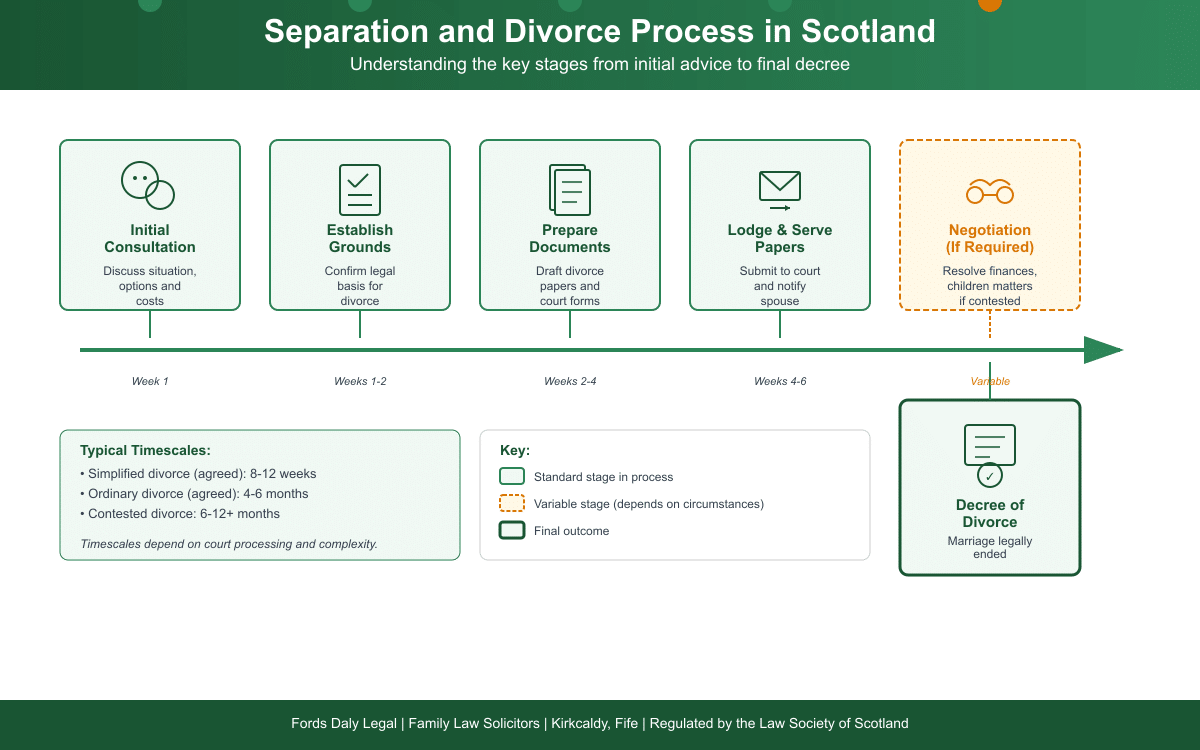
Simplified divorces, where all matters are agreed and there are no children under 16, can often be completed within 8-12 weeks. Ordinary divorces typically take 4-6 months where matters are largely agreed, though complex cases involving financial disputes or contested arrangements for children may take considerably longer.
We’ll give you realistic timescales based on your specific circumstances and keep you informed of progress throughout the process.

Why Choose Fords Daly Legal
Clients across Kirkcaldy, Glenrothes, Dunfermline, Leven, and throughout Fife choose Fords Daly Legal for separation and divorce matters because of our approachable, balanced, and professional approach:
- Clear, plain-English advice – we explain the law and your options without unnecessary jargon
- Strong understanding of Scots family law – our team has extensive experience handling separation and divorce matters under Scottish legislation
- Local, accessible service – based in Kirkcaldy, we serve clients throughout Fife with easy access for appointments and court attendances
- A focus on practical outcomes – we’re solution-oriented, helping you achieve fair results without unnecessary conflict or expense
- Regulated by the Law Society of Scotland – you can be confident in the professional standards and protections that apply
- Supportive and measured approach – we understand this is a difficult time and treat every client with empathy and respect
Our aim is to help you move forward with clarity and confidence, knowing your legal matters are being handled competently and with your best interests at heart.
Take the Next Step
If you’re facing separation or divorce in Scotland, whether in Kirkcaldy, Fife, or the surrounding areas, Fords Daly Legal is here to help. Taking early advice can make a real difference to the outcome and help you avoid common pitfalls.
📞 Call us on 01592 640630 to speak with a member of our family law team
✉️ Email us with your enquiry
🏢 Visit our office in Kirkcaldy for a confidential consultation
The sooner you get advice, the sooner you can understand your position and start planning your next steps. Contact us today to arrange an initial discussion.

Frequently Asked Questions About Separation and Divorce in Scotland
Do I need to be separated before I can divorce in Scotland?
In many cases, yes. Separation for a qualifying period—either one year with consent or two years without—is one of the main ways to establish the irretrievable breakdown of a marriage. However, if your spouse has committed adultery or behaved unreasonably, you may be able to divorce without needing to wait for a period of separation. We can advise which ground is most appropriate in your circumstances.
How long does a divorce take in Scotland?
Timescales vary considerably depending on your circumstances. A simplified divorce where all matters are agreed can be completed in 8-12 weeks. Ordinary divorces where matters are largely agreed typically take 4-6 months. Cases involving disputed finances, contested child arrangements, or a defending spouse may take significantly longer. We’ll give you realistic timescales based on your specific situation.
Do I need a solicitor to get divorced in Scotland?
A solicitor is not legally required for a simplified divorce, and you can apply directly to the court yourself. However, legal advice is strongly recommended wherever finances, property, or children are involved. A solicitor can ensure your financial settlement is fair and properly documented, help you understand your rights, and avoid costly mistakes. For ordinary divorces, professional representation is particularly important.
Can divorce be handled without going to court?
Divorce in Scotland is a court process, meaning papers must be lodged with and processed by the court. However, many divorces proceed without either party needing to attend a court hearing in person. Where matters are agreed or undefended, the court can grant the divorce based on the written paperwork alone. Only contested cases typically require attendance at hearings.
What if my spouse does not agree to the divorce?
You can still obtain a divorce even if your spouse doesn’t consent. After two years of separation, their consent is not required. Alternatively, if you can establish unreasonable behaviour or adultery, you may be able to proceed immediately without consent. Where a spouse actively defends the divorce proceedings, the case may require court hearings to resolve, but obtaining a divorce is still possible.
What's the difference between separation and divorce?
Separation means you and your spouse are living apart but remain legally married. Divorce is the legal process that formally ends the marriage. You can be separated indefinitely without ever divorcing, though this may have implications for financial matters, inheritance, and future relationships. Many people choose to formalise their separation through a separation agreement before later proceeding to divorce.
How are finances divided in a Scottish divorce?
Scotland has specific rules about the division of matrimonial property. Generally, assets acquired during the marriage (the ‘matrimonial property’) are subject to fair sharing between the parties. This includes the family home, savings, investments, and pension rights built up during the marriage. The starting point is equal division, though the court can adjust this based on various factors. We can explain how these rules apply to your specific financial circumstances.
What happens to our house when we divorce?
The family home is usually one of the most significant assets to be divided. Options typically include selling the property and dividing the proceeds, one party buying out the other’s share, or transferring ownership to one party in exchange for other assets or as part of a broader financial settlement. Where there are children, their housing needs are an important consideration. We can advise on the options available in your situation.
How are arrangements for children decided?
The welfare of children is always the court’s paramount concern. Parents are encouraged to agree arrangements for residence (where children live) and contact (time spent with each parent) between themselves. Where parents cannot agree, either can apply to the court for a residence or contact order. The court will make decisions based on what is in the best interests of the children, taking into account their views depending on their age and maturity.
Can I get a divorce if we're still living in the same house?
Yes, it’s possible to be ‘separated’ while still living under the same roof, though this can be more difficult to prove. The key question is whether you are living separate lives – sleeping apart, not eating together, not sharing household tasks as a couple, and generally operating as two separate households within the same property. Documentary evidence and witness statements may be helpful in establishing separation in these circumstances.
What is a separation agreement?
A separation agreement is a formal, legally binding document that sets out the arrangements you and your spouse have agreed regarding finances, property, and children. It provides certainty and can help avoid disputes later. While not required for divorce, a well-drafted separation agreement can protect both parties’ interests and, in many cases, form the basis of the eventual financial settlement on divorce.
How much does divorce cost in Scotland?
Costs vary significantly depending on the complexity of your case. Simplified divorces tend to be relatively inexpensive, involving court fees plus modest legal fees if you use a solicitor. Ordinary divorces cost more, particularly where there are financial matters to resolve or contested issues. Defended divorces that proceed to court hearings are the most expensive. We provide clear information about likely costs at the outset and keep you informed as your case progresses.
Related Services
Separation and divorce often involve related legal matters. You may also find the following services helpful:
- Financial Provision on Divorce – Advice on the fair division of assets, pensions, and maintenance payments
- Separation Agreements – Formal agreements documenting arrangements during separation
- Child Residence and Contact – Arrangements for where children live and time with each parent
- Cohabitation Disputes – Legal advice for unmarried couples who are separating
- Conveyancing – Assistance with property transfers as part of your separation or divorce