
Dealing with Estates (Executry) in Scotland
Dealing with estates in Kirkcaldy, Fife involves managing a person’s affairs after death and ensuring their estate is distributed correctly under Scots law. At Fords Daly Legal, we provide clear, practical support with executry administration, guiding executors and families through every step of this important process with care, professionalism, and genuine understanding of what you’re going through.
When someone dies, there is often a great deal to manage at what is already a deeply difficult time. Alongside personal loss, legal and financial responsibilities arise that must be handled correctly and within specific legal requirements. Whether the estate is straightforward or involves complex assets, the process can feel overwhelming without proper guidance.
Dealing with an estate – often referred to as executry work in Scotland – involves identifying assets, settling debts, and distributing what remains to beneficiaries. Fords Daly Legal supports executors and families across Kirkcaldy, Glenrothes, Dunfermline, Leven, and throughout Fife, explaining each stage in plain English and managing the legal work on your behalf so you can focus on what matters most.
Quick Navigation

What Is Executry Work?
Executry work is the legal process of administering a deceased person’s estate in Scotland. This involves several key responsibilities that must be carried out correctly to ensure the estate is handled lawfully and that beneficiaries receive their entitlements.
The process begins with confirming who is entitled to act as executor—the person or persons legally responsible for managing the estate. The executor must then identify and value all assets belonging to the deceased, from property and bank accounts to investments, vehicles, and personal possessions.
Once assets are identified, the executor must obtain Confirmation from the Sheriff Court. Confirmation is the Scottish equivalent of probate in England and Wales, and it provides the legal authority needed to access and manage the deceased’s assets.
After Confirmation is granted, the executor pays any outstanding debts, liabilities, and taxes before distributing the remaining estate to beneficiaries—either according to the deceased’s Will or, where no valid Will exists, under Scotland’s rules of intestacy.
The executry process can be straightforward in some cases and considerably more complex in others, depending on the size of the estate, the types of assets involved, and whether any disputes or complications arise.
What Our Executry Service Includes
When you instruct Fords Daly Legal to deal with an estate, we provide comprehensive support throughout the entire executry process. Our experienced team handles the legal and administrative work, allowing you to focus on your family during this difficult time.
Our executry service includes:
- Initial consultation and advice: We explain the executry process, discuss your specific circumstances, and advise on the best approach for your situation.
- Executor guidance: We advise executors on their duties, responsibilities, and legal obligations, ensuring you understand what’s required at each stage.
- Asset identification and valuation: We help identify all estate assets, obtain valuations where required, and compile a comprehensive estate inventory.
- Confirmation application: We prepare and submit the application for Confirmation to the Sheriff Court, handling all necessary documentation.
- Liaising with institutions: We deal with banks, building societies, investment providers, pension companies, and other organisations on your behalf.
- Tax advice: We advise on inheritance tax, income tax, and capital gains tax implications, working with HMRC as required.
- Debt settlement: We ensure all legitimate debts and liabilities are properly settled before distribution.
- Estate distribution: We distribute the estate to beneficiaries according to the Will or intestacy rules.
- Final accounts: We prepare detailed final accounts showing all estate transactions, providing full transparency for beneficiaries.
We handle the process efficiently while keeping you informed at every stage, providing regular updates and responding promptly to your questions.
Estates With and Without a Will
The executry process differs depending on whether the deceased left a valid Will. Both situations have specific legal requirements that must be followed carefully.
Where There Is a Will
When the deceased left a valid Will, the executor named in the document is usually entitled to act. The Will sets out the deceased’s wishes regarding who should inherit and in what proportions. Our role is to ensure these wishes are carried out correctly while meeting all legal requirements.
It’s worth noting that in Scotland, certain family members have ‘legal rights’ to a share of the estate regardless of what the Will says. We advise on these rights and how they affect estate distribution.
Where There Is No Will (Intestacy)
When someone dies without a valid Will, their estate is distributed according to Scotland’s rules of intestacy. These rules determine who is entitled to inherit based on family relationships, which may not reflect what the deceased would have wished.

In intestacy cases, a close family member (usually the surviving spouse or civil partner, or a child) can apply to act as executor-dative. We guide families through this process and ensure the estate is administered lawfully according to intestacy rules.
We advise on both situations, ensuring the correct procedures are followed and that the estate is administered properly, protecting both executors and beneficiaries.

Common Situations We Help With
Every estate is different, and at Fords Daly Legal, we have experience helping families navigate a wide range of circumstances. Here are some common situations where we provide support:
- Straightforward estates: Where the deceased left a clear Will and assets are easily identifiable, we ensure the process runs smoothly and efficiently.
- Complex estates: Where there are multiple properties, business interests, overseas assets, or trusts involved, we have the expertise to manage complexity.
- Inheritance tax estates: Where the estate exceeds the nil-rate band, we advise on tax liabilities and work with HMRC to ensure correct reporting.
- Intestacy cases: Where there is no Will, we guide families through the additional steps required and explain who inherits under Scottish law.
- Disputed estates: Where beneficiaries disagree or someone wishes to challenge the Will, we advise on rights and options.
- Executor support: Where you’ve been named executor but feel uncertain about your responsibilities, we provide guidance and practical help.
Supporting Executors and Families
Acting as an executor can feel overwhelming, particularly for those who have never dealt with an estate before. The responsibility is significant, and the process involves tasks that may be unfamiliar and time-consuming.
We understand that every executor’s needs are different. Some prefer comprehensive legal support, allowing us to handle the entire process from start to finish. Others wish to take a more hands-on approach, dealing with certain tasks themselves while receiving professional guidance where needed.
Fords Daly Legal adapts our service to suit your circumstances. We offer as much or as little support as you require, and we’re always available to answer questions and provide reassurance along the way.
Our aim is to reduce stress and ensure the estate is dealt with properly, efficiently, and with the sensitivity that this difficult time demands. We work at your pace, keeping you informed and involved at every stage.
Timeline: How Long Does Executry Take?
The time required to administer an estate varies considerably depending on its complexity. While every case is different, understanding the typical stages and timescales can help you plan and set expectations.
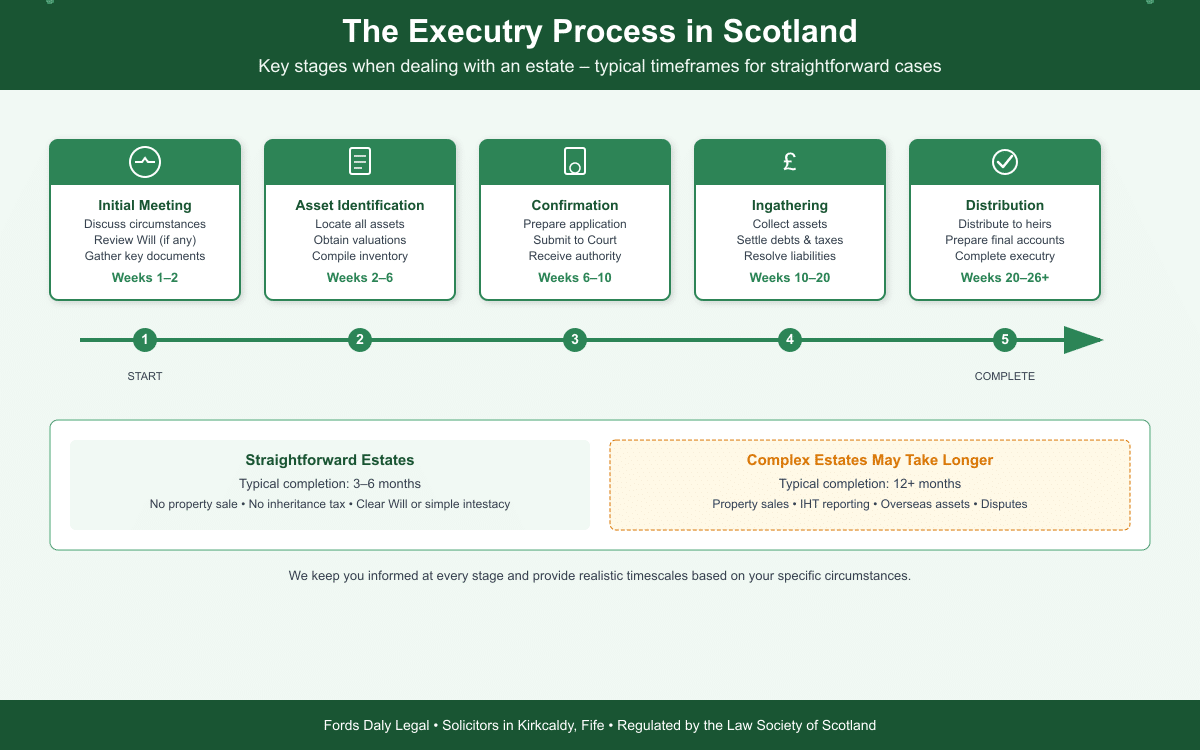
A straightforward estate with no property to sell and no inheritance tax complications might be completed within three to six months. More complex estates—particularly those involving property sales, business assets, inheritance tax, or overseas elements—may take twelve months or longer.
Factors that can extend timescales include: estates that exceed the inheritance tax threshold, properties that need to be sold, assets held overseas, disputes between beneficiaries, and difficulty tracing beneficiaries.
At Fords Daly Legal, we work efficiently to progress your case while ensuring nothing is overlooked. We’ll give you a realistic estimate of timescales based on your specific circumstances and keep you updated on progress throughout.

Why Choose Fords Daly Legal
Clients throughout Kirkcaldy, Glenrothes, Dunfermline, Leven, and across Fife choose Fords Daly Legal for executry work because of our practical advice, supportive approach, and commitment to making a difficult process as straightforward as possible.
- Clear communication: We explain the executry process in plain English, avoiding legal jargon and ensuring you understand each step.
- Scots law expertise: Our team has in-depth knowledge of Scottish succession law, ensuring your estate is handled correctly.
- Local presence: Based in Kirkcaldy, we serve families throughout Fife with accessible, personal service.
- Sensitive approach: We understand the emotional challenges of bereavement and handle every case with care and compassion.
- Proactive service: We anticipate issues before they arise and keep the process moving forward efficiently.
- Transparent fees: We discuss costs openly from the outset, with no hidden charges or unexpected expenses.
- Regulated service: As a firm regulated by the Law Society of Scotland, we adhere to the highest professional standards.
We focus on providing reassurance and clarity at every stage, helping you navigate the executry process with confidence.
Take the Next Step
If you’re acting as an executor or need to deal with an estate in Scotland, Fords Daly Legal is here to help. Whether you’re in Kirkcaldy, Glenrothes, Dunfermline, Leven, or anywhere else in Fife, our experienced team can guide you through the executry process with clarity and compassion.
📞 Call us on 01592 640630 to speak with our team
✉️ Email us with your enquiry
🏢 Visit our Kirkcaldy office for a face-to-face consultation
Contact us early. The sooner you have professional support in place, the smoother the process will be. We’re here to take the burden off your shoulders during this difficult time.

Frequently Asked Questions About Dealing with Estates (Executry) in Scotland
What is Confirmation and why do I need it?
Confirmation is the legal document issued by the Sheriff Court that gives an executor authority to deal with the deceased’s estate in Scotland. It’s the Scottish equivalent of probate in England and Wales. Without Confirmation, you generally cannot access bank accounts, sell property, or collect assets belonging to the deceased. Confirmation is required for most estates, though some small estates and jointly held assets may be accessible without it.
Do I need a solicitor to deal with an estate?
A solicitor is not legally required to administer an estate—executors can handle the process themselves. However, professional legal advice can help avoid costly mistakes, prevent delays, and ensure you meet your legal obligations correctly. Many executors find that having a solicitor manage the process reduces stress significantly and gives them peace of mind that everything is being handled properly.
How long does executry administration typically take?
Timescales vary depending on the estate’s complexity. A straightforward estate might be completed in three to six months, while more complex cases can take twelve months or longer. Factors that affect timing include whether property needs to be sold, inheritance tax requirements, overseas assets, and whether any disputes arise. We’ll give you a realistic estimate based on your specific circumstances.
What happens if there is no Will?
When someone dies without a valid Will (intestate), their estate is distributed according to Scotland’s rules of intestacy. These rules set out who inherits based on family relationships—typically the surviving spouse or civil partner and children first, then other relatives. The rules may not reflect what the deceased would have wished. A family member must apply to the court to be appointed as executor-dative before the estate can be administered.
Am I personally liable as an executor?
Executors have significant legal responsibilities and can be held personally liable for mistakes – for example, if they distribute the estate before paying all debts, or if they fail to account for inheritance tax correctly. This is why professional advice is valuable: it helps ensure you fulfil your duties properly and protects you from potential liability. Acting honestly and following proper procedures is essential.
Can I decline to act as executor?
Yes, being named as an executor in a Will does not oblige you to act. If you don’t wish to take on the role – perhaps due to time constraints, distance, or the complexity involved – you can decline (renounce). If there are other executors named, they can act instead. If you’re the only executor, someone else (usually a beneficiary) can apply to be appointed in your place. We can advise on your options if you’re unsure whether to accept the role.
What are 'legal rights' in Scotland and how do they affect the estate?
Legal rights are protections in Scots law that ensure surviving spouses, civil partners, and children cannot be entirely disinherited. Even if a Will leaves everything to someone else, these family members are entitled to claim a share of the deceased’s ‘moveable estate’ (essentially everything except land and buildings). These rights must be considered when distributing an estate, and beneficiaries may need to decide whether to accept what the Will provides or claim their legal rights instead.
What is inheritance tax and does it apply to the estate?
Inheritance tax (IHT) is a tax on estates above a certain value. Currently, the nil-rate band is £325,000, with an additional residence nil-rate band of up to £175,000 available in certain circumstances. Estates below these thresholds typically don’t pay IHT. Transfers between spouses and civil partners are usually exempt. Where IHT is payable, it must generally be paid before Confirmation can be granted, which can require careful planning. We advise on tax implications and ensure correct reporting to HMRC.
How are funeral costs and debts paid from the estate?
Funeral costs are typically the first expense paid from the estate, followed by any debts the deceased owed. Executors must settle all legitimate debts before distributing anything to beneficiaries. If the estate doesn’t have enough assets to cover debts (an ‘insolvent estate’), specific rules apply about which creditors are paid first. We help executors identify debts, verify claims, and ensure everything is paid in the correct order.
What if beneficiaries disagree or someone wants to challenge the Will?
Disputes can arise for various reasons—disagreements about the Will’s interpretation, questions about its validity, or claims that the deceased lacked capacity when making it. In such cases, it’s important to seek legal advice promptly. Executors must act impartially and cannot favour one beneficiary over another. Where disputes cannot be resolved through negotiation, court action may be necessary. We can advise on your rights and options.
How much does executry work cost?
Costs depend on the estate’s size and complexity. Some solicitors charge a percentage of the estate value, while others charge based on time spent. At Fords Daly Legal, we discuss fees openly from the outset, explaining our charging structure and providing estimates so you know what to expect. Solicitors’ fees are a legitimate estate expense and are paid from the estate rather than by the executor personally
Can I start dealing with the estate before Confirmation is granted?
Some initial steps can and should be taken before Confirmation – such as registering the death, arranging the funeral, securing the property, and gathering information about assets. However, you generally cannot access bank accounts, sell assets, or collect debts owed to the estate until Confirmation is granted. The period before Confirmation is mainly about information gathering and preparation, so that once you have legal authority, you can progress matters efficiently.
Related Services
Dealing with estates often connects with other aspects of personal legal planning. You may also find the following Fords Daly Legal services helpful:
Making a Will
Having witnessed the challenges that can arise when someone dies without a clear Will, many clients choose to put their own affairs in order. A professionally drafted Will ensures your wishes are clearly recorded and makes the executry process much smoother for your loved ones.
Making a Power of Attorney
A Power of Attorney allows you to appoint someone you trust to manage your affairs if you become unable to do so yourself. It’s an important safeguard that sits alongside your Will as part of comprehensive estate planning.
Estate Planning
Our estate planning service helps you structure your assets to minimise inheritance tax, protect wealth for future generations, and ensure your estate is distributed according to your wishes with minimum complication.
Residential Property Sales
If the estate includes property that needs to be sold, our conveyancing team can handle the sale efficiently, working alongside our executry service to ensure a coordinated approach.