
Estate Planning in Scotland
Estate planning in Kirkcaldy, Fife helps you protect your assets, provide for your family, and plan ahead with confidence. Fords Daly Legal offers clear, practical estate planning advice to ensure your wishes are understood, legally effective, and as tax-efficient as possible under Scots law. Whether you are planning for the future, reviewing existing arrangements, or responding to a change in circumstances, we provide the guidance you need.
Estate planning is about more than deciding who inherits what. It involves taking a considered approach to how your assets are managed during your lifetime and how they are dealt with after your death. This includes putting appropriate legal documents in place, reviewing how property and investments are owned, and considering future risks and opportunities that may affect you and your family.
At Fords Daly Legal, we work with clients across Kirkcaldy, Glenrothes, Dunfermline, Leven, and throughout Fife to create estate plans that reflect personal, family, and financial circumstances. Our approach is straightforward and practical, ensuring you understand each step and feel confident about the decisions you make.
Quick Navigation
On this page:
- What Is Estate Planning?
- What Estate Planning Can Include
- When to Consider Estate Planning
- Tailored Advice for Changing Circumstances
- Reducing Uncertainty and Future Disputes
- Understanding Inheritance Tax in Scotland
- Timeline: How Long Does Estate Planning Take?
- Why Choose Fords Daly Legal
- Frequently Asked Questions

What Is Estate Planning?
Estate planning is the process of organising your affairs so that your wishes are carried out both during your lifetime and after your death. It brings together different areas of personal legal work into a coordinated plan that protects you, your family, and your assets.
At its core, estate planning involves putting appropriate legal documents in place, reviewing how assets are owned, and considering future risks and opportunities. This might include making a Will, setting up Powers of Attorney, reviewing property ownership, and considering the inheritance tax implications of your estate.
The aim is to create clarity, reduce risk, and ensure your intentions are respected. A well-considered estate plan provides peace of mind for you and reassurance for your family, knowing that your affairs are in order and your wishes are clearly documented.
What Estate Planning Can Include
Estate planning often brings together several areas of personal legal work into one comprehensive approach. The specific elements will depend on your circumstances, the size of your estate, and your family situation.
Your estate plan may include:
- Making or Reviewing a Will: Ensuring your assets pass to the people you choose and that your executors have clear instructions.
- Powers of Attorney: Putting Continuing and Welfare Powers of Attorney in place so trusted people can manage your affairs if you become unable to do so.
- Property Ownership Review: Examining how property is held and whether the current title arrangements support your wishes.
- Care Planning: Considering how potential care needs might be funded and what arrangements would protect your assets while ensuring you receive appropriate care.
- Inheritance Tax Planning: Reviewing your estate to identify opportunities for reducing inheritance tax within the current legal framework.
- Business Succession: Planning for the future of business or agricultural assets, including succession planning and protecting business continuity.
- Provision for Vulnerable Beneficiaries: Creating arrangements such as trusts to provide for children, grandchildren, or beneficiaries who may need protection or support.
We take a joined-up approach so each element works together effectively. Rather than treating your Will, Powers of Attorney, and other documents in isolation, we ensure they complement each other and collectively achieve your goals.
When to Consider Estate Planning
Estate planning is not just for later life or for those with substantial wealth. There are many situations where taking time to plan ahead can make a significant difference to you and your family.
Starting a Family
If you have children or are expecting a child, estate planning ensures they would be provided for and that guardianship arrangements are in place.
Buying Property
Acquiring your first home or additional properties is often a good time to consider how those assets should be held and what happens to them in different scenarios.
Marriage or Civil Partnership
Getting married affects your legal position and existing Will arrangements. It is important to review your estate plan at this stage.

Separation or Divorce
Changes to your relationship status require careful review of your Will, any Powers of Attorney, and beneficiary designations.
Receiving an Inheritance
Coming into money or property can significantly change your estate and may create new planning opportunities or considerations.
Retirement
As you approach or enter retirement, reviewing your estate plan ensures your arrangements remain appropriate for this new phase of life.
Health Concerns
If you or a family member develops health issues, having proper arrangements in place becomes particularly important for peace of mind.

Tailored Advice for Changing Circumstances
Estate planning is not a one-size-fits-all exercise. What works for one family may not be appropriate for another, and your own circumstances will change over time.
Family structures, asset values, and personal priorities can all evolve. Marriage, separation, the birth of children or grandchildren, acquiring property, selling a business, or receiving an inheritance can all affect whether existing arrangements remain appropriate.
We provide tailored advice that takes account of your specific situation. This means understanding not just your assets, but your family relationships, your concerns, and what matters most to you. We then help you put arrangements in place that truly reflect your wishes.
We also encourage regular reviews to ensure your estate plan continues to work as intended. Life changes, tax rules evolve, and what seemed right five years ago may no longer be the best approach. Periodic reviews help keep your planning current and effective.
Reducing Uncertainty and Future Dispute
Clear planning can help reduce the risk of disputes after death. When intentions are unclear or documents are ambiguous, confusion and conflict between family members can follow. This can cause lasting damage to family relationships at an already difficult time.
Ambiguity, outdated documents, or informal arrangements are common causes of disagreement. A Will that was written many years ago may not reflect current circumstances. Verbal promises about who should receive particular items can lead to disputes. Property held jointly may not pass in the way you intended.
Careful estate planning helps avoid these issues by setting out your intentions clearly and legally. We work with you to identify potential areas of uncertainty and ensure your documents leave no room for doubt about your wishes.
Where appropriate, we also discuss steps that can help reduce delays and administrative burdens for those dealing with your estate. This might include ensuring executors have access to necessary information, reviewing how accounts and investments are held, and putting practical arrangements in place to make administration smoother.
Understanding Inheritance Tax in Scotland
Inheritance tax (IHT) is a UK-wide tax that can apply to estates above certain thresholds. While not everyone will have an IHT liability, rising property values mean that more families are finding their estates may be affected.
The current nil-rate band allows estates up to a certain value to pass free of inheritance tax. There is also a residence nil-rate band that may apply when you leave your home to direct descendants. Gifts made during your lifetime may also be exempt or partially exempt depending on the timing and circumstances.
Estate planning can help identify opportunities to reduce your potential inheritance tax liability within the current legal framework. This might include making use of exemptions, considering lifetime gifts, reviewing how assets are held between spouses, or using trusts where appropriate.
It is important to take advice before making significant changes, as tax planning must be balanced against your own needs and the potential consequences of giving away assets. We provide clear guidance on your options and help you make informed decisions about what is right for your situation.
Timeline: How Long Does Estate Planning Take?
The time needed for estate planning depends on the complexity of your circumstances. A straightforward plan involving a Will and Powers of Attorney can often be completed within a few weeks. More complex arrangements involving multiple properties, business assets, or trust structures may take longer to develop and implement.
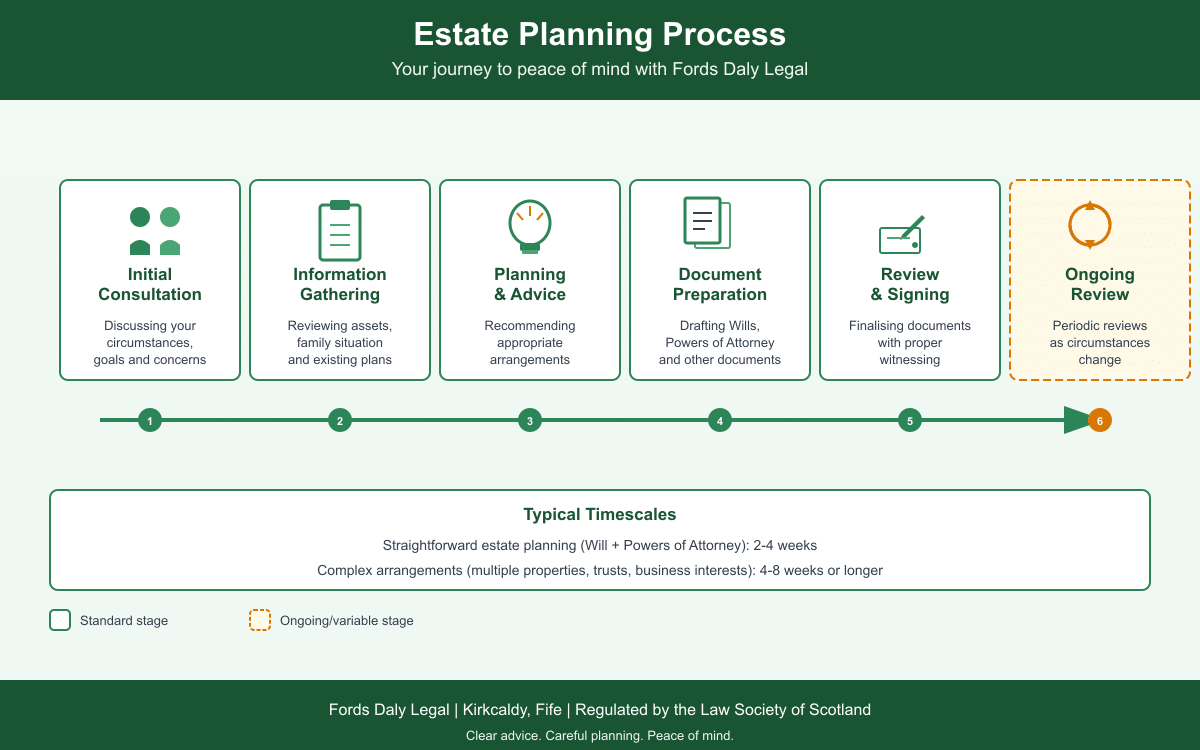
We work efficiently to progress matters, but we also ensure you have time to consider your options carefully. Estate planning involves important decisions, and we encourage you to take the time you need to feel confident about the arrangements you put in place.

Why Choose Fords Daly Legal
Clients choose Fords Daly Legal for estate planning because of our practical, thoughtful approach and our commitment to clear communication.
- Clear, Plain-English Advice: We explain estate planning in straightforward terms, avoiding unnecessary legal jargon and ensuring you understand your options.
- Strong Understanding of Scots Law: Scottish succession and property law differs from England and Wales. We have deep expertise in the Scottish legal framework that applies to your estate.
- Local Service Across Fife: Based in Kirkcaldy, we serve clients throughout Fife including Glenrothes, Dunfermline, Leven, and surrounding areas. We are accessible and easy to reach.
- Joined-Up Approach: We cover Wills, Powers of Attorney, executry matters, and related services, allowing us to take a coordinated approach to your planning.
- Regulated by the Law Society of Scotland: You can be confident that we meet the professional standards required of Scottish solicitors.
- Competitive, Transparent Fees: We provide clear information about costs so you know what to expect from the outset.
Our focus is on helping you plan with confidence and peace of mind. We take time to understand your situation and work with you to create an estate plan that truly reflects your wishes and protects your family.
Take the Next Step
If you are considering estate planning in Kirkcaldy, Fife, or the surrounding areas, Fords Daly Legal can help. Whether you are starting from scratch, reviewing existing arrangements, or responding to a change in your circumstances, we provide the clear, practical advice you need.
📞 Call us to arrange a consultation
✉️ Email your enquiry and we will get back to you promptly
🏢 Visit our office in Kirkcaldy for a face-to-face meeting
Taking time to plan now can provide lasting peace of mind for you and reassurance for your family. Contact Fords Daly Legal today to take a proactive approach to protecting your future.

Frequently Asked Questions About Estate Planning in Scotland
Is estate planning only for wealthy individuals?
No. Estate planning is relevant for anyone who wants clarity and control over how their affairs are managed. Even if your estate is modest, having proper arrangements in place ensures your wishes are respected and can make things much easier for your family. Estate planning is about organisation and peace of mind, not just wealth.
Do I need a Will as part of estate planning?
In most cases, yes. A Will is a central part of effective estate planning because it allows you to specify who should inherit your assets and who should administer your estate. Without a Will, Scottish intestacy rules determine how your estate is distributed, which may not match your wishes. A Will also allows you to appoint guardians for minor children and include specific gifts or instructions.
How often should I review my estate plan?
We recommend reviewing your estate plan after any major life event such as marriage, divorce, the birth of children or grandchildren, acquiring or selling significant assets, or if there are changes to your health. Even without specific changes, a review every three to five years is sensible to ensure your arrangements remain appropriate and to account for any changes in the law or your circumstances.
Can estate planning help reduce inheritance tax?
In some cases, yes. Estate planning can help identify opportunities to reduce your potential inheritance tax liability within the current legal framework. This might include making use of exemptions, considering lifetime gifts, reviewing how assets are held between spouses, or using trusts where appropriate. However, tax planning must be balanced against your own needs, and you should take professional advice before making significant changes.
Can estate planning help if I become unable to manage my affairs?
Yes. Powers of Attorney form an important part of planning for potential loss of capacity. A Continuing Power of Attorney allows someone you trust to manage your financial affairs if you become unable to do so, while a Welfare Power of Attorney covers decisions about your health and personal welfare. Having these in place before they are needed avoids the need for court applications and gives you control over who makes decisions on your behalf.
What is the difference between a Will and estate planning?
A Will is a single document that specifies what happens to your assets after death. Estate planning is a broader process that may include making a Will but also encompasses other elements such as Powers of Attorney, reviewing property ownership, considering inheritance tax implications, and planning for potential care needs. Estate planning takes a comprehensive view of your affairs and ensures all the different elements work together effectively.
How does Scottish succession law differ from English law?
Scotland has its own legal system with different rules around succession and property. Key differences include Legal Rights, which give your spouse or civil partner and children a right to claim a portion of your moveable estate regardless of what your Will says. Property law also differs, including how property can be held by couples. If you have assets in Scotland, it is important to work with a solicitor who understands the Scottish legal framework.
Can I include my business in my estate plan?
Yes, and it is often important to do so. Business succession planning ensures your business interests are dealt with appropriately if you die or become incapacitated. This might involve considering who should inherit or take over the business, how it should be valued, and whether any reliefs from inheritance tax might apply. We can work with you to ensure your business is properly addressed within your overall estate plan.
What happens if I die without an estate plan?
If you die without a Will, Scottish intestacy rules determine how your estate is distributed. This may not match your wishes. Your spouse or civil partner and children have automatic entitlements under these rules, which could mean your estate is divided differently than you intended. Without Powers of Attorney, if you lose capacity during your lifetime, your family may need to apply to court for authority to manage your affairs, which can be expensive and time-consuming.
Do I need to update my estate plan after getting married?
Yes. In Scotland, unlike England, marriage does not automatically revoke a Will. However, getting married significantly changes your legal position, and your existing Will may not provide appropriately for your new spouse or reflect your changed circumstances. It is important to review your Will and wider estate plan after marriage to ensure your arrangements are appropriate and your spouse is properly provided for.
How much does estate planning cost?
The cost of estate planning depends on the complexity of your circumstances and the documents required. A straightforward estate plan involving a Will and Powers of Attorney will cost less than a complex plan involving multiple properties, business interests, or trust structures. We provide clear information about our fees at the outset so you know what to expect. Contact us to discuss your circumstances and we can provide a tailored quote.
Can estate planning protect assets if I need care in the future?
Estate planning can include consideration of how potential care needs might be funded. While it is important to be aware that local authorities can look back at transfers of assets when assessing care funding, there may be legitimate planning opportunities depending on your circumstances. We can discuss your situation and explain the options available to you, always ensuring any planning is appropriate and properly considered.
Related Services
Estate planning often involves several related areas of personal legal work. You may also find the following services helpful:
- Making a Will: Ensure your wishes are clearly documented and your assets pass to the people you choose.
- Making a Power of Attorney: Put arrangements in place so trusted people can manage your affairs if you become unable to do so.
- Dealing with Estates (Executry): Our team can help administer the estate of someone who has died, handling the legal and practical aspects of executry work.
- Residential Conveyancing: If your estate plan involves reviewing or changing property ownership, our conveyancing team can assist.
- Family Law: Changes to your family circumstances may affect your estate plan. Our family law team can advise on the implications.
- Business Legal Services: If your estate includes business interests, our commercial team can help with succession planning and related matters.