
Making a Power of Attorney in Scotland
Making a Power of Attorney in Kirkcaldy, Fife and the surrounding areas allows you to decide who will manage your affairs if you are ever unable to do so yourself. At Fords Daly Legal, we provide clear, practical advice to help you put the right type of Power of Attorney in place under Scots law, giving you reassurance and control over future decision-making.
A Power of Attorney is one of the most important legal documents you can put in place during your lifetime. It allows you to appoint someone you trust—known as your attorney—to act on your behalf, either for a specific purpose or in case you lose capacity due to illness, accident or age-related conditions such as dementia.
At Fords Daly Legal, we advise clients across Kirkcaldy, Glenrothes, Dunfermline, Leven and throughout Fife on Powers of Attorney that are legally sound and tailored to individual circumstances. We explain the options clearly, including the different types available in Scotland, so you can make informed decisions with confidence.
Quick Navigation

What Is a Power of Attorney?
A Power of Attorney is a legal document that authorises another person, known as an attorney, to act on your behalf. The attorney can be a family member, trusted friend, or professional—the choice is entirely yours.
In Scotland, different types of Power of Attorney exist to suit different needs. Some are designed for short-term or specific situations, while others are intended to continue if you lose capacity. Choosing the correct type is essential, as not all Powers of Attorney provide the same level of protection.
Unlike an English Lasting Power of Attorney, Scottish Powers of Attorney are governed by the Adults with Incapacity (Scotland) Act 2000. This means if you live in Scotland or have assets here, it is important to have a Power of Attorney that complies with Scots law.
.
Types of Power of Attorney in Scotland
There are three types of Power of Attorney recognised in Scotland, and it is important to understand how they differ.
General Power of Attorney
A General Power of Attorney gives someone authority to manage your financial and property affairs, usually for a specific purpose or limited period.
This type of Power of Attorney was the only option available before the introduction of the Adults with Incapacity (Scotland) Act 2000. Crucially, a General Power of Attorney automatically comes to an end if you lose capacity or die. For this reason, it is not suitable for future planning where incapacity is a concern.
General Powers of Attorney are still useful in certain situations, such as where someone needs help managing affairs temporarily, while they are abroad, or during a period of planned hospitalisation.
Continuing Power of Attorney
A Continuing Power of Attorney covers financial and property matters, such as managing bank accounts, paying bills, dealing with investments or handling the sale of property.
Unlike a General Power of Attorney, a Continuing Power of Attorney continues to have effect if you lose capacity, provided it has been properly drafted and registered with the Office of the Public Guardian (Scotland). This makes it a key document for long-term planning and peace of mind.
You can specify whether your Continuing Power of Attorney takes effect immediately upon registration or only upon loss of capacity—the choice depends on your personal circumstances and preferences.
Welfare Power of Attorney
A Welfare Power of Attorney allows your attorney to make personal welfare decisions on your behalf if you lose capacity. This can include decisions about:
- Where you live and your living arrangements
- Health care and medical treatment
- Personal care and daily routines
- Social activities and contact with others
Welfare powers only come into effect once you are no longer able to make these decisions yourself. This is assessed by medical professionals at the relevant time.
Many people choose to grant both Continuing and Welfare Powers of Attorney together—often in a single document—to ensure comprehensive protection for both financial and personal welfare matters.
What Our Power of Attorney Service Includes
When you instruct Fords Daly Legal to prepare a Power of Attorney, we provide clear advice and full support throughout the process, including:
- Discussing your circumstances, concerns and objectives in detail
- Advising on the most appropriate type of Power of Attorney for your situation
- Helping you choose suitable attorneys and substitute attorneys
- Explaining the powers you can grant and any restrictions you may wish to include
- Drafting a legally valid document tailored to your specific needs
- Arranging the required certificate of capacity from a practising solicitor
- Registering the Power of Attorney with the Office of the Public Guardian (Scotland)
- Advising on safe storage and when and how the document should be used
- Providing certified copies for banks, financial institutions and other organisations

We ensure the document is clear, effective and fully compliant with the Adults with Incapacity (Scotland) Act 2000.

Why Acting Early Matters
A Continuing or Welfare Power of Attorney can only be granted while you have legal capacity—that is, while you can understand the nature and effect of what you are signing. If capacity is lost before a Power of Attorney is in place, your family members may face significant difficulties.
Without a valid Power of Attorney, relatives may need to apply to the court for a Guardianship Order to gain authority to act on your behalf. This court process can be:
- Stressful and emotionally difficult for families
- Time-consuming, often taking several months
- Expensive, with legal fees and court costs
- Restrictive, with ongoing court supervision
Putting the correct Power of Attorney in place while you are well allows you to remain in control of who makes decisions on your behalf. It also avoids unnecessary stress, delay and expense for your loved ones at what may already be a difficult time.
Timeline: How Long Does It Take?
The time required to put a Power of Attorney in place depends on several factors, including the complexity of your circumstances and how quickly the Office of the Public Guardian processes the registration.
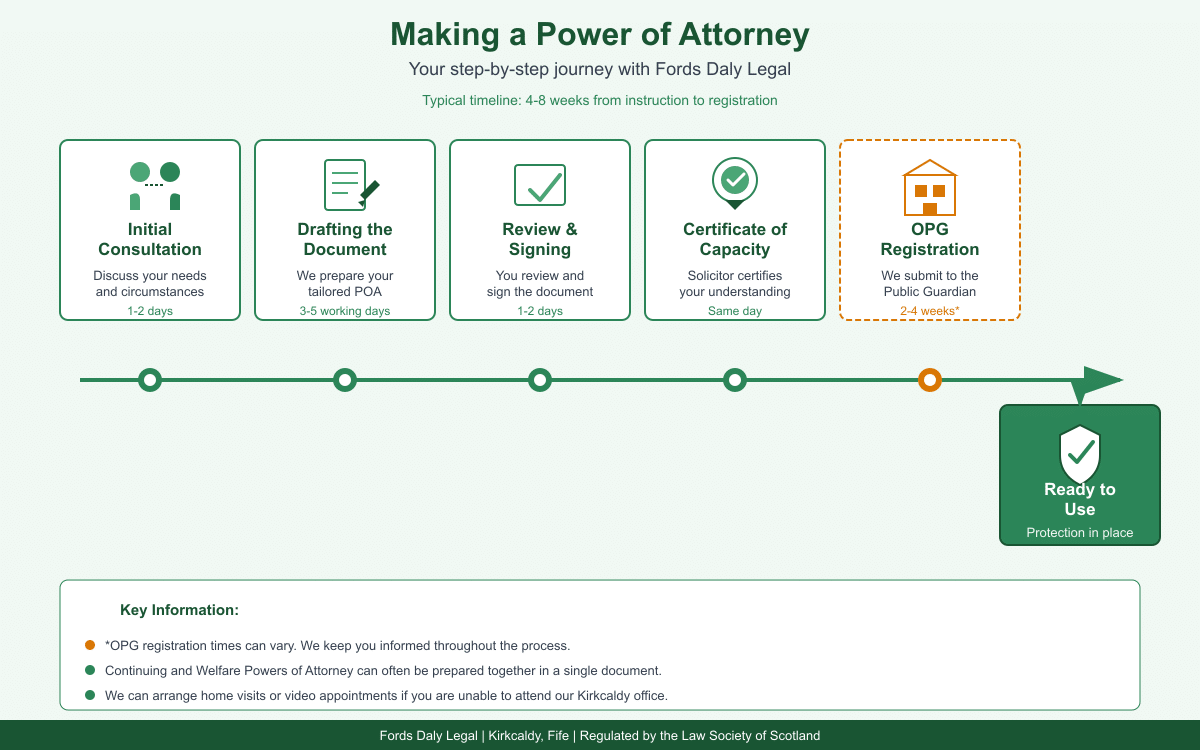
A typical timeline for making a Power of Attorney is:
- Initial consultation and instructions: 1-2 days
- Drafting the document: 3-5 working days
- Review and signing appointment: 1-2 days
- Certificate of capacity: Same day as signing
- Registration with Office of the Public Guardian: 2-4 weeks
In total, most Powers of Attorney are fully registered and ready to use within 4-8 weeks of your initial instruction. We keep you informed at every stage and can advise if any issues arise during registration.

Why Choose Fords Daly Legal
Clients throughout Kirkcaldy, Glenrothes, Dunfermline, Leven and the wider Fife area choose Fords Daly Legal for their Power of Attorney because of our clear advice and careful, client-focused approach.
- Plain-English explanations: We explain all available options without unnecessary legal jargon, so you can make informed decisions
- Strong understanding of Scots law: Our team has detailed knowledge of the Adults with Incapacity (Scotland) Act 2000 and capacity issues
- Local, accessible service: Based in Kirkcaldy with easy access from across Fife, we offer in-person, telephone and video appointments
- Sensitive handling: We understand that planning for incapacity involves personal and sometimes difficult conversations
- Regulated by the Law Society of Scotland: You can be confident that we meet the highest professional standards
- Competitive, transparent fees: We provide clear fee information upfront so you know what to expect
Our focus is on ensuring your wishes are respected, your interests are protected, and your family has the legal authority they need if the time comes.
Take the Next Step
If you are considering making a Power of Attorney in Scotland – whether you live in Kirkcaldy, Fife or the surrounding areas – Fords Daly Legal is here to help. Our experienced team can guide you through the process, explain your options clearly, and ensure the right arrangements are in place for your future.
📞 Call us on 01592 640630 to speak with our team
✉️ Email us with your enquiry
🏢 Visit our office in Kirkcaldy – appointments available Monday to Friday
The sooner you put a Power of Attorney in place, the sooner you’ll have peace of mind knowing your affairs are protected. Contact us today to arrange an initial consultation.

Frequently Asked Questions About Making a Power of Attorney in Scotland
Do I need a solicitor to make a Power of Attorney in Scotland?
A solicitor is not legally required, but professional advice is strongly recommended. A solicitor ensures the correct type of Power of Attorney is used, that the document is properly drafted to meet your needs, and that all legal requirements are satisfied. Importantly, a Continuing or Welfare Power of Attorney requires a certificate of capacity, which is usually provided by a practising solicitor.
What is the difference between a General and Continuing Power of Attorney?
The key difference is what happens if you lose capacity. A General Power of Attorney ends automatically if you lose the ability to make decisions for yourself. A Continuing Power of Attorney remains valid even after you lose capacity, making it essential for long-term planning. If you want your attorney to be able to help you in the event of dementia, stroke or other incapacity, you need a Continuing Power of Attorney.
When does a Continuing or Welfare Power of Attorney take effect?
A Continuing Power of Attorney can take effect immediately upon registration or only upon loss of capacity, depending on how it is drafted. Many people choose immediate effect so their attorney can help with day-to-day matters if needed. A Welfare Power of Attorney only takes effect once you have lost capacity to make the relevant welfare decisions yourself—this is assessed by medical professionals at the time.
Can I appoint more than one attorney?
Yes. You can appoint multiple attorneys and specify how they should act, either jointly (all must agree) or jointly and severally (each can act independently). You can also appoint substitute attorneys who can step in if your primary attorney is unable or unwilling to act. We can advise on the best arrangement for your circumstances.
What happens if I lose capacity without a Power of Attorney in place?
If you lose capacity without a Power of Attorney, your family or others may need to apply to the court for a Guardianship Order to gain legal authority to manage your affairs. This process is more complex, time-consuming and expensive than making a Power of Attorney in advance. It can take several months, and the court may impose ongoing supervision requirements.
Can I still make a General Power of Attorney?
Yes. General Powers of Attorney are still valid in Scotland and can be useful in certain situations, for example, if you need someone to manage your affairs for a specific purpose or while you are abroad. However, because a General Power of Attorney ends if you lose capacity, it is not suitable for long-term incapacity planning. Most people benefit from a Continuing Power of Attorney instead.
How much does a Power of Attorney cost?
The cost of making a Power of Attorney varies depending on the complexity of your circumstances and whether you need both Continuing and Welfare powers. We provide clear fee information at the outset so you know what to expect. There is also a registration fee payable to the Office of the Public Guardian. Contact us for a quote tailored to your needs.
Does my Power of Attorney need to be registered?
Yes. A Continuing or Welfare Power of Attorney must be registered with the Office of the Public Guardian (Scotland) before it can be used. We handle the registration process on your behalf and advise when the document is ready to use. General Powers of Attorney do not need to be registered, but registration provides important benefits including a record of the document’s existence.
Can I change or cancel my Power of Attorney later?
Yes, provided you still have legal capacity. You can revoke (cancel) your Power of Attorney at any time by signing a deed of revocation and notifying the Office of the Public Guardian. If your circumstances change—for example, your relationship with your attorney breaks down—we can advise on the steps needed to update or replace your Power of Attorney.
What powers can I give to my attorney?
You have flexibility over the powers you grant. For a Continuing Power of Attorney, this might include managing bank accounts, paying bills, dealing with investments, selling property, or running a business. For a Welfare Power of Attorney, powers can cover decisions about medical treatment, care arrangements, and where you live. You can also include specific restrictions or guidance for your attorney.
Who can be an attorney?
Anyone aged 16 or over who has legal capacity can act as your attorney, provided they are not bankrupt (for financial powers). Most people choose a spouse, partner, adult child, or trusted friend. You can also appoint a professional, such as a solicitor or accountant. The most important factor is that you trust the person completely to act in your best interests.
Will my English Power of Attorney work in Scotland?
Not automatically. An English Lasting Power of Attorney is governed by different legislation and may not be recognised by Scottish banks, institutions or authorities. If you have moved to Scotland or have assets here, we recommend putting a Scottish Power of Attorney in place. We can advise on how your English and Scottish documents work together.
Related Services
You may also find the following personal legal services helpful:
- Making a Will: Ensure your assets pass to your chosen beneficiaries and appoint guardians for any minor children. A Will works alongside your Power of Attorney to provide comprehensive protection for your family
- Dealing with Estates (Executry): When someone passes away, we can help with the legal process of administering their estate, including obtaining Confirmation (the Scottish equivalent of probate) and distributing assets to beneficiaries
- Estate Planning: Plan for the future with advice on inheritance tax, trusts, and protecting assets for future generations. Estate planning often includes Powers of Attorney as part of a broader strategy
- Guardianship Applications: If a family member has already lost capacity without a Power of Attorney in place, we can help with applications to the court for Guardianship Orders.