
Making a Will in Scotland
Making a Will in Kirkcaldy, Fife and the surrounding areas ensures that your wishes are clearly recorded and legally effective under Scots law. Fords Daly Legal provides clear, practical advice to help you put a valid Will in place, giving you peace of mind that your estate will be dealt with exactly as you intend.
Making a Will is one of the most important steps you can take to protect your family, your assets and your wishes after your death. Despite this, many people delay putting a Will in place, often because they believe it is complicated or something they can deal with later. In reality, the process is far more straightforward than most people expect, and having a professionally drafted Will provides invaluable security for you and your loved ones.
At Fords Daly Legal, we help individuals and families across Kirkcaldy, Glenrothes, Dunfermline, Leven and throughout Fife to make Wills that are clear, legally sound and tailored to their circumstances. We explain your options in plain English and guide you through the process with care and sensitivity, ensuring you feel comfortable and informed at every stage.
Quick Navigation

Why Making a Will Matters
Without a valid Will, your estate will be dealt with under the rules of intestacy. These rules are fixed by Scottish law and may not reflect your wishes at all. This can lead to unintended outcomes, delays in settling your estate, and additional stress for your loved ones at an already difficult time.
For example, under intestacy rules, unmarried partners have no automatic right to inherit anything from your estate, regardless of how long you have been together. Similarly, stepchildren you may have raised as your own would not inherit unless you have formally adopted them. A Will allows you to make sure the people you care about are properly provided for.
A properly drafted Will allows you to decide:
- Who inherits your estate and in what shares
- Who will act as executor and deal with your affairs after your death
- Guardianship arrangements for your children if they are under 16
- Whether specific gifts or legacies should be left to particular people or charities
- How inheritance tax planning opportunities can be addressed
- Funeral wishes and any other personal instructions
Having a Will in place gives clarity and reassurance at a difficult time, helping your family focus on what matters most rather than navigating legal uncertainty.
What Our Will-Making Service Includes
When you instruct Fords Daly Legal to prepare your Will, we take the time to understand your circumstances and what matters most to you. We do not rush through the process or use generic templates that may not fit your situation.
Our Will-making service includes:
- A detailed initial consultation to discuss your assets, family situation and wishes
- Clear advice on how Scots law affects succession and what happens to your estate
- Drafting a clear, legally valid Will tailored to your specific circumstances
- Guidance on choosing executors, guardians and beneficiaries
- Advice on any potential issues, such as legal rights claims or inheritance tax
- Arranging the formal signing and witnessing of your Will
- Providing guidance on storing your Will safely and ensuring your executors can locate it
- A copy of your completed Will for your records
We ensure your Will reflects your intentions and complies fully with Scottish law. If your circumstances are more complex, we can also advise on matters such as trusts, business succession and estate planning strategies.
Common Situations Where a Will is Essential
Every person’s situation is different, and a Will should always reflect individual needs. Some Wills are relatively straightforward, while others require more careful consideration and drafting. Here are some situations where professional advice is particularly important:
Married Couples and Civil Partners
Many people assume their spouse or civil partner will automatically inherit everything, but this is not always the case under Scottish law. If you have children, your spouse may only be entitled to a share of your estate, with the remainder passing to your children. A Will allows you to make appropriate provision for your spouse while also considering your children’s future.
Unmarried Couples
Cohabiting couples have no automatic inheritance rights in Scotland. If you are living with a partner but are not married or in a civil partnership, you should make a Will to ensure they are provided for. Without a Will, your partner could be left with nothing, even if you have been together for many years.

Blended Families
If you have children from a previous relationship, or your partner has children who are not biologically yours, careful drafting is essential. A Will can help ensure that all children you wish to benefit are included, and that your estate is distributed fairly between your current partner and your children.
Business Owners
If you own a business or hold shares in a company, your Will should address what happens to your business interests on your death. This might include provisions for selling your share to business partners or passing the business to a family member. Without proper planning, your death could disrupt the business and affect employees and customers.
Parents of Young Children
If you have children under 16, your Will is the appropriate place to appoint guardians who would look after them if both parents were to die. Choosing the right guardians and documenting your wishes gives you peace of mind that your children would be cared for by people you trust.

Reviewing and Updating Your Will
A Will is not something that should be written once and forgotten. Your circumstances will change over time, and your Will should change with them.
Major life events that may affect your Will include:
- Marriage or entering a civil partnership (which may revoke an existing Will)
- Divorce or separation
- The birth or adoption of children or grandchildren
- The death of a beneficiary or executor named in your Will
- Buying or selling property
- Significant changes in your financial circumstances
- Moving to or from Scotland
We recommend reviewing your Will every few years, or whenever a significant change occurs in your life. We can advise on whether a complete new Will is needed or whether a codicil (a formal amendment to your existing Will) would be more appropriate.
Our Fees
We believe in transparent pricing. The cost of making a Will depends on the complexity of your circumstances, but we will always provide a clear estimate before any work begins.
For straightforward single Wills, our fees typically start from £150 plus VAT. Mirror Wills for couples (where both partners make similar Wills leaving their estate to each other) are available at a reduced combined rate. More complex Wills involving trusts, business interests or detailed estate planning may cost more, and we will discuss this with you at the outset.
Contact us for a no-obligation quote based on your specific situation.
Timeline: How Long Does Making a Will Take?
The time required to complete your Will depends on the complexity of your circumstances and how quickly you can provide us with the information we need. For most clients, the process takes between two and four weeks from initial consultation to signing.
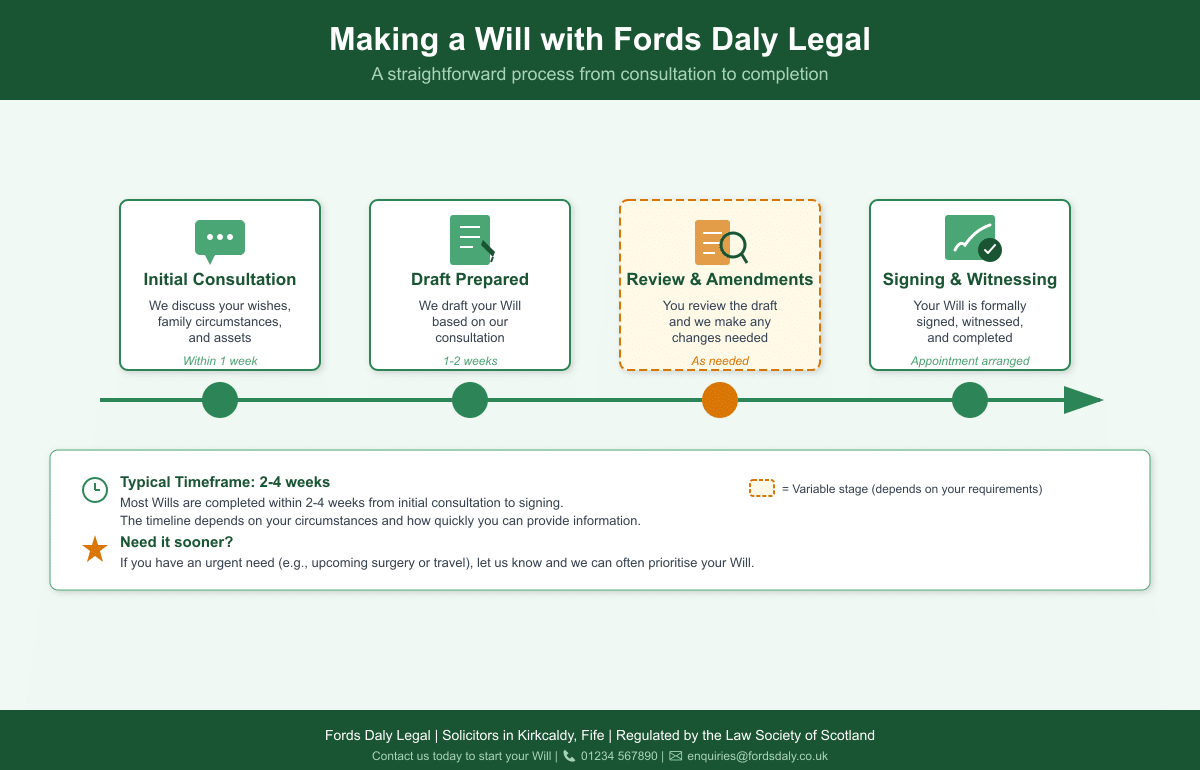
If your situation is urgent, for example if you are about to undergo surgery or travel abroad, we can often prioritise your Will and complete it more quickly. Please let us know if this applies to you.

Why Choose Fords Daly Legal
Clients across Kirkcaldy, Glenrothes, Dunfermline, Leven and throughout Fife choose Fords Daly Legal to make their Wills because of our approachable and practical approach.
- Clear, jargon-free advice in plain English that you can understand
- Strong understanding of Scots law and Scottish succession rules
- Regulated by the Law Society of Scotland, giving you confidence in our standards
- Local service with knowledge of the Fife community
- Sensitive, patient handling of personal and family matters
- Competitive, transparent fees with no hidden costs
- Convenient appointments at times that suit you
Our aim is to make the process of making a Will straightforward and reassuring. We take the time to listen to your concerns, answer your questions, and ensure you feel confident that your wishes will be carried out.
Take the Next Step
If you are considering making a Will in Scotland, whether you live in Kirkcaldy, Glenrothes, Dunfermline, Leven or elsewhere in Fife, Fords Daly Legal is here to help. Our experienced team will guide you through the process with care, clarity and professionalism.
📞 Call us on 01592 640630 to arrange a consultation
✉️ Email us with your enquiry
🏢 Visit us at our Kirkcaldy office
The sooner you put a Will in place, the sooner you can have peace of mind that your wishes will be respected and your loved ones protected. Get in touch today to take the first steps.

Frequently Asked Questions About Making a Will in Scotland
Do I need a solicitor to make a Will in Scotland?
While it is technically possible to write a Will yourself, using a solicitor helps ensure it is legally valid, properly witnessed, and accurately reflects your wishes. A poorly drafted Will can lead to disputes, delays, or your intentions not being carried out. Professional advice is particularly important if your circumstances involve property, business interests, children, or potential claims against your estate.
What happens if I die without a Will in Scotland?
If you die without a valid Will (known as dying “intestate”), your estate will be distributed according to Scottish intestacy rules. These rules set out a fixed order of priority for who inherits, starting with your spouse or civil partner and children. Unmarried partners have no automatic right to inherit anything, and the distribution may not reflect what you would have wanted. Intestacy can also cause delays and additional costs in administering your estate.
Can I change my Will after it has been signed?
Yes, you can change your Will at any time, provided you have the mental capacity to do so. Minor changes can sometimes be made using a codicil (a formal amendment), while more significant changes usually require a completely new Will. We recommend reviewing your Will regularly and updating it when your circumstances change
What is the difference between a Will and a Power of Attorney?
A Will only takes effect after your death and deals with how your estate should be distributed. A Power of Attorney takes effect during your lifetime and allows someone you trust to manage your affairs if you become unable to do so yourself, for example due to illness or incapacity. Both documents are important parts of planning for the future, and many clients choose to put both in place at the same time.
Who should I choose as my executor?
Your executor is the person responsible for administering your estate after your death, including gathering your assets, paying any debts, and distributing the estate to your beneficiaries. Most people choose a family member, trusted friend, or a professional such as a solicitor. It is sensible to choose someone who is organised, trustworthy, and willing to take on the responsibility. You can name more than one executor if you wish.
Can I leave my estate to charity in my Will?
Yes, you can leave gifts to charities in your Will. This can be a specific sum of money, a particular item, or a share of your overall estate. Charitable legacies may also reduce the amount of inheritance tax payable on your estate. We can advise on how to include charitable gifts effectively.
What happens to my Will if I get married or divorced?
In Scotland, marriage does not automatically revoke a Will, but divorce automatically removes your ex-spouse from your Will unless you make specific arrangements to the contrary. It is strongly recommended that you review and update your Will after any change in marital status to ensure it still reflects your wishes. Failing to do so could result in unintended consequences.
Where should my Will be kept?
Your Will should be stored safely and your executors should know where to find it. Options include keeping it at home in a fireproof safe, lodging it with your solicitor, or registering it with the Scottish Register of Wills. We can advise on the best option for your circumstances and provide secure storage if required.
Can I disinherit someone from my Will?
You have considerable freedom to decide who benefits from your Will. However, in Scotland, certain relatives (including your spouse, civil partner, and children) have “legal rights” to a share of your moveable estate (such as money and investments) regardless of what your Will says. We can explain how legal rights work and help you plan accordingly.
What if I own property in more than one country?
If you own assets in different countries, you may need to consider how each country’s succession laws apply. It may be appropriate to have a separate Will for your Scottish assets and another for assets elsewhere. We can advise on the Scottish aspects and coordinate with lawyers in other jurisdictions if needed.
How much does making a Will cost?
The cost of making a Will varies depending on the complexity of your circumstances. Simple Wills typically start from around £150 plus VAT, while more complex Wills involving trusts or business interests may cost more. We provide transparent quotes before work begins, so you know exactly what to expect. Contact us for a no-obligation estimate.
Can I write my own Will without a solicitor?
While you can write your own Will, this carries significant risks. Homemade Wills are more likely to contain errors, ambiguities, or fail to meet legal requirements. This can lead to your wishes not being carried out, disputes among your family, or additional costs to resolve problems after your death. For peace of mind, professional advice is strongly recommended.
Related Services
Making a Will is often part of a broader approach to planning for the future. You may also find the following services helpful:
- Making a Power of Attorney: Appoint someone you trust to manage your affairs if you become unable to do so yourself.
- Dealing with Estates (Executry): Guidance and support for executors administering the estate of someone who has died.
- Estate Planning: Strategies to protect your assets, minimise inheritance tax, and provide for your family.
- Buying or Selling a House: If property forms part of your estate, our conveyancing team can assist with any transactions.
- Family Law: Advice on matters such as separation, divorce, and arrangements for children that may affect your Will.