
Discharging a Security in Scotland
Discharging a security in Kirkcaldy, Fife and throughout Scotland is the legal process of removing a mortgage or secured loan from your property’s title once it has been repaid. At Fords Daly Legal, we provide clear, practical advice to ensure your discharge is handled correctly and properly registered under Scottish property law.
When you pay off a mortgage or secured loan, the security registered against your property does not automatically disappear. A formal legal process is required to remove it from the title. Without this step, your property records will continue to show a lender holding rights over your home—even though you owe them nothing.
Discharging a security is an important step whether you are selling your property, re-mortgaging with a new lender, or simply want your title to accurately reflect your ownership position. Fords Daly Legal assists homeowners across Kirkcaldy, Glenrothes, Dunfermline, Leven and throughout Fife with discharging securities efficiently, correctly, and with minimum fuss.
Quick Navigation

What Is a Security?
In Scotland, a security (sometimes called a standard security) is the legal document that gives a lender rights over a property as protection for a loan. Most commonly, this takes the form of a mortgage—where your lender registers their interest against your property’s title as security for the money they have lent you.
The security is registered against the title at Registers of Scotland and remains in place until it is formally discharged. This means that even if the loan has been fully repaid, the security continues to appear on the title until the correct legal steps are taken to remove it.
Think of it this way: paying off your mortgage settles your debt to the lender, but it does not automatically update your property’s legal records. The discharge process is what formally removes the lender’s registered interest and confirms you own the property free of that particular security.
When Is a Security Discharged?
A security is typically discharged in several common situations:
Selling Your Property
When you sell your home, your existing mortgage is repaid from the sale proceeds at settlement. The security must be discharged to allow the buyer to receive a clear title. Your solicitor coordinates this with your lender as part of the conveyancing process, ensuring the discharge is registered promptly.
Re-mortgaging with a New Lender
If you switch to a new mortgage provider, your old lender’s security must be discharged before (or simultaneously with) your new lender’s security being registered. This ensures there is no confusion about which lender has priority rights over your property.
Paying Off Your Mortgage in Full
Some homeowners pay off their mortgage through regular payments, lump sum payments, or inheritance. Once the loan is fully repaid, you may wish to have the security discharged so your title accurately reflects that you own the property outright with no lending secured against it.
Clearing Historic Securities
Sometimes older securities from previous loans or historic lenders remain on a title even though the debt was repaid years ago. These need to be properly discharged to avoid complications in future transactions.
In each of these situations, the discharge must be properly documented and registered with Registers of Scotland to be legally effective.

What Our Discharging a Security Service Includes
When you instruct Fords Daly Legal to discharge a security, we handle the complete legal process from start to finish:
Confirming Repayment Details
We contact your lender to obtain accurate redemption figures and confirm the exact amount required to settle your loan. This ensures there are no surprises and that the discharge can proceed smoothly once payment is made.
Preparing and Reviewing Documentation
We prepare or review the discharge documentation to ensure it meets all legal requirements. This includes checking that the discharge accurately identifies the property and the security being removed.
Coordinating with Your Lender
We liaise with your lender to ensure they execute the discharge correctly and return it promptly. Different lenders have different processes, and we know how to navigate
Registering the Discharge
Once we have the executed discharge, we submit it to Registers of Scotland for registration. This is the step that formally removes the security from your property’s title and updates the public record.
Confirming Completion
After registration, we confirm that your title has been updated and the security has been removed. We keep you informed throughout the process so you know exactly when everything has been completed.
Avoiding Problems with Property Titles
An undischarged or incorrectly discharged security can cause significant problems, particularly when you come to sell or re-mortgage your property in the future.
Common Issues We Help Prevent
- Sale delays: Buyers and their solicitors will identify undischarged securities during their searches. This can delay or even derail a sale if not addressed quickly.
- Re-mortgage complications: New lenders will not proceed until existing securities are properly discharged, potentially causing you to lose favourable interest rates.
- Historic lender issues: Older mortgages from lenders who have merged, been taken over, or ceased trading can be particularly difficult to discharge if not handled correctly.
- Additional costs: Rectifying problems with undischarged securities later often costs more than doing it properly in the first place.
By ensuring your discharge is properly completed and registered, we help you avoid these issues and ensure your property title is accurate and up to date.
Timeline: How Long Does It Take?
The time required to discharge a security depends on several factors, including lender response times and Registers of Scotland processing times. Here is a typical timeline:
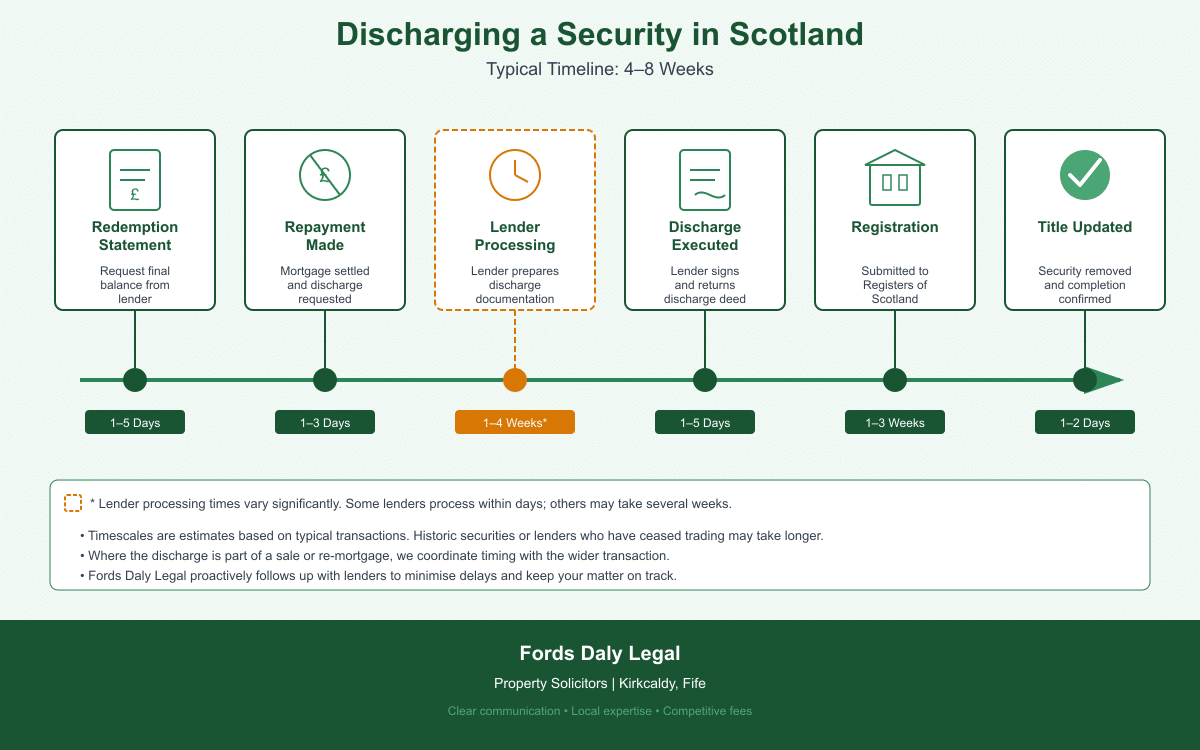
Most straightforward discharges are completed within 4 to 8 weeks from instruction. However, this can vary depending on your lender’s internal processes and current registration volumes at Registers of Scotland. Where a sale or re-mortgage is involved, we coordinate the discharge timing with the wider transaction to ensure everything proceeds smoothly.
Historic securities or those involving lenders who have merged or ceased trading may take longer to resolve. We will give you a realistic estimate of timescales based on your specific circumstances.
Costs
The cost of discharging a security depends on whether it forms part of a wider transaction or is being done as a standalone matter.
As Part of a Sale or Re-mortgage
Where the discharge is part of selling your property or re-mortgaging, our fee for handling the discharge is typically included within our overall conveyancing quote. We will confirm this when providing your estimate.
Standalone Discharge
If you simply want to discharge a security after paying off your mortgage (without any sale or re-mortgage), we can handle this as a standalone matter. Our fees for standalone discharges are competitive and we will provide a clear quote before you commit.
Additional Costs
In addition to our legal fees, there are registration dues payable to Registers of Scotland for recording the discharge. We will advise you of all costs upfront so there are no surprises.
Contact us for a personalised quote based on your specific circumstances
Why Choose Fords Daly Legal
Clients across Kirkcaldy, Glenrothes, Dunfermline, Leven and throughout Fife choose Fords Daly Legal to discharge their securities because of our careful approach and clear communication:
- Experienced conveyancing team: Our solicitors have extensive experience in Scottish residential property law and understand the requirements for properly discharging securities.
- Local knowledge: Based in Kirkcaldy, we understand the Fife property market and have established relationships with local lenders and Registers of Scotland.
- Efficient handling: We proactively follow up with lenders to ensure discharges are processed promptly, minimising delays to your transaction.
- Clear communication: We explain the process in plain English and keep you informed at every stage, so you always know what is happening with your discharge.
- Regulated by the Law Society of Scotland: As a regulated Scottish law firm, you can be confident that your matter will be handled to the highest professional standards.
- Competitive fees: We offer straightforward pricing with no hidden costs, so you know exactly what you are paying for.
Our focus is on ensuring your property title is accurate and up to date, giving you peace of mind that your ownership position is properly reflected in the public records
Take the Next Step
If you need to discharge a security in Scotland—whether in Kirkcaldy, Glenrothes, Dunfermline, Leven, or anywhere in Fife—Fords Daly Legal can help. Our experienced conveyancing team will guide you through the process and ensure your property title is updated correctly.
📞 Call us on 01592 640630 to discuss your dischare requirements
✉️ Email us with your enquiry
🏢 Visit us at our Kirkcaldy office for a face-to-face consultation
The sooner you instruct us, the sooner we can begin the process of clearing your title. Get in touch today and let us take care of the legal work for you.

Frequently Asked Questions About Discharge of a Security in Scotland
Does a mortgage automatically come off the title once it is paid?
No. Even after your mortgage has been fully repaid, the security remains registered against your property’s title until a formal legal discharge is registered with Registers of Scotland. Paying off your debt settles your obligation to the lender, but it does not automatically update the Land Register. A discharge document must be prepared, executed by your lender, and submitted for registration to formally remove the security from your title.
Do I need a solicitor to discharge a security in Scotland?
Yes. Discharging a security involves preparing legal documentation and registering it with Registers of Scotland. A qualified Scottish solicitor is required to handle this process and ensure it is completed correctly. While some lenders may offer to arrange their own discharge, having your own solicitor ensures your interests are protected and the discharge is properly registered.
Is a discharge of security always required when selling a house?
Yes. Any existing security must be discharged at settlement so the buyer receives a clear title. The buyer’s solicitor will insist on this, and their lender (if they have a mortgage) will require it before releasing funds. Your solicitor coordinates the discharge as part of the sale transaction, ensuring it is completed simultaneously with settlement.
How long does it take to discharge a security?
Most straightforward discharges are completed within 4 to 8 weeks, depending on how quickly your lender processes the discharge request and current registration times at Registers of Scotland. Where the discharge is part of a sale or re-mortgage, we coordinate the timing to ensure the transaction proceeds smoothly. More complex situations, such as historic securities or lenders who have ceased trading, may take longer to resolve.
How long does a transfer of title take in Scotland?
Timescales vary depending on the complexity of your situation. A straightforward transfer with no mortgage involvement can often be completed within two to four weeks. If lender consent is required, the process typically takes four to six weeks, though this depends on how quickly the lender responds. We’ll give you a realistic estimate based on your specific circumstances.
Can an old or historic security still affect my property?
Yes. Even securities from loans that were repaid many years ago can cause problems if they were never properly discharged. When you come to sell or re-mortgage, a buyer’s solicitor or new lender will identify these historic entries and require them to be cleared before proceeding. Dealing with old securities can be more complicated, especially if the original lender has merged with another institution or ceased trading. It is always better to address these issues sooner rather than later.
What happens if my original lender no longer exists?
If your original lender has been taken over, merged with another institution, or ceased trading, the discharge process may be more complex. We have experience tracing successor organisations and obtaining discharges in these situations. In some cases, we may need to obtain court authority to clear the title. We will advise you on the best approach and likely timescales based on your specific circumstances.
What is the difference between a discharge and redemption?
Redemption refers to paying off your mortgage—settling the debt you owe to your lender. Discharge refers to the legal process of removing the security from your property’s title. You need to redeem (pay off) your mortgage before the lender will grant a discharge. Redemption settles your financial obligation; discharge updates the Land Register to reflect that the lender no longer has any secured interest in your property.
Can I have more than one security on my property?
Yes. It is possible to have multiple securities registered against a property, such as a first mortgage and a second charge for a secured loan. Each security must be separately discharged when the relevant debt is repaid. When selling, all securities must be discharged to give the buyer clear title. We can advise on the priority of securities and coordinate multiple discharges if required.
What if I want to discharge my security but not sell or re-mortgage?
You can absolutely have your security discharged as a standalone matter after paying off your mortgage, even if you have no immediate plans to sell or re-mortgage. Many homeowners choose to do this for peace of mind, knowing their title accurately reflects their ownership position. We offer standalone discharge services at competitive rates.
Will I receive confirmation when the discharge is complete?
Yes. Once Registers of Scotland has processed the discharge and updated your title, we will confirm completion to you. You will have peace of mind knowing the security has been formally removed from the Land Register. If you wish, you can also request an updated title sheet from Registers of Scotland to verify the changes.
Related Services
You may also find the following residential property services useful:
- Selling a House in Scotland – Our full conveyancing service for selling your home, including coordination of security discharges.
- Residential Estate Agency – Marketing your property to find the right buyer at the best price
- Buying a House in Scotland – Our in-house estate agency for marketing and selling your property in Fife.
- Re-mortgaging – Legal assistance when switching to a new mortgage provider, including discharge of your existing security.
- Transfer of Title – Transferring property ownership between family members or into joint names.