
Transfer of Title in Scotland
Whether you need to add someone to your property title, remove a name following separation, or transfer ownership for family or tax planning reasons, Fords Daly Legal in Kirkcaldy, Fife provides clear, practical guidance through every step. A transfer of title changes who legally owns a property without the need for a conventional sale, and while no money may change hands, the legal process must be completed correctly to protect everyone involved.
Transfers of title arise in many different circumstances. You might be going through a separation or divorce and need to transfer sole ownership to one party. Perhaps you’re adding a spouse or partner to the title after marriage, or a parent wishes to gift a property to their children. Some transfers are carried out as part of estate planning, while others follow a change in family arrangements. Whatever your situation, the legal requirements are the same: the transfer must be properly documented and registered with the Land Register of Scotland.
At Fords Daly Legal, we advise clients across Kirkcaldy, Glenrothes, Dunfermline, Leven, and throughout Fife on all aspects of property ownership transfers. We take a careful, client-focused approach, explaining each stage in plain English so you understand what is happening and why it matters. Our aim is to make the process as straightforward as possible while ensuring your property ownership is properly recorded and legally sound.
Quick Navigation

When Is a Transfer of Title Needed?
A transfer of title is required whenever the legal ownership of a property changes without a traditional sale taking place. Unlike buying or selling a home, there is no exchange of purchase price, but the legal process of changing ownership is just as important. Without proper documentation and registration, future complications can arise when you try to sell, re-mortgage, or pass on the property.
The most common situations where a transfer of title is needed include:
- Separation or divorce: When a couple separates and one party will retain the family home, the other person’s name needs to be removed from the title. This may form part of a wider financial settlement.
- Adding a spouse or partner: After marriage or when a relationship becomes more established, couples often choose to add a partner to the property title so both names appear as joint owners.
- Gifting property to family members: Parents may wish to transfer a property to their children, either outright or while retaining the right to live there. This requires careful consideration of the legal and tax implications.
- Estate and tax planning: Some transfers are made as part of inheritance tax planning, though professional advice should be sought on the tax consequences before proceeding.
- Changing from sole to joint ownership: A sole owner may want to add another person to the title, or joint owners may wish to change how the property is held between them.
- Removing a deceased person: When a joint owner passes away, their name needs to be removed from the title so the surviving owner can deal with the property.
Whatever the reason for your transfer, the legal requirements must be completed correctly. Our team will guide you through the process and ensure your ownership change is properly documented.

What Our Transfer of Title Service Includes
When you instruct Fords Daly Legal to handle your transfer of title, we manage every aspect of the legal process from start to finish. Our service is designed to be straightforward and stress-free, with clear communication at every stage.
Our comprehensive service includes:
Initial consultation and advice
We begin by understanding your circumstances and explaining how the transfer will work. We’ll identify any potential issues early and advise on the best way forward.
Title examination
We review the existing title deeds to confirm the current ownership position and identify any restrictions, burdens, or conditions that may affect the transfer.
Ownership structure advice
Where relevant, we advise on how the property should be held after the transfer, including the implications of joint ownership versus sole ownership.
Document preparation
We prepare all necessary legal documentation, including the disposition (the document that transfers ownership) and any supporting paperwork.
Lender liaison
If the property has a mortgage, we communicate with your lender to obtain any necessary consent and ensure their requirements are met.
LBTT consideration
We advise on whether Land and Buildings Transaction Tax applies to your transfer and, if so, handle the submission of returns to Revenue Scotland.
Registration
We submit the transfer to Registers of Scotland and ensure the new ownership is properly recorded on the Land Register.
Completion confirmation
Once registration is complete, we provide you with confirmation and copies of the updated title documentation.
Throughout the process, we keep you informed of progress and explain each step in plain English. You’ll always know what is happening and what comes next.
Transfers Involving a Mortgage
If the property being transferred is subject to a mortgage, additional steps are required. The lender has a security interest in the property, and any change to who owns it will require their involvement.
In most cases, lender consent must be obtained before the transfer can proceed. The lender will want to be satisfied that the person or people who will own the property after the transfer can meet the mortgage obligations. This may involve the lender carrying out affordability checks on the new owner or owners.
There are several scenarios that commonly arise:
- Transfer of Equity: Where one party is removed from the title but the mortgage continues in the remaining owner’s name, the lender will need to agree to release the outgoing party from the mortgage obligations.
- Adding someone to the mortgage: If you’re adding a person to the title, the lender may require them to also become a party to the mortgage.
- Re-mortgaging: In some cases, a new mortgage is needed as part of the transfer. This might happen where the outgoing owner needs to be bought out, or where the existing lender will not consent to the transfer.
We manage all communications with your lender and coordinate the various requirements so the transfer can proceed smoothly. If a re-mortgage is needed, we can handle the conveyancing for that at the same time.
Common Types of Title Transfer
Every transfer of title has its own circumstances, but some situations arise more frequently than others. Here are the most common types of transfer we handle for clients across Fife.
Transfer Following Separation or Divorce
We provide clear, competitive fee quotes for re-mortgage work. Our fees cover all the legal work described above, and we’ll confirm the exact amount before you instruct us. There are no hidden charges.
Adding a Spouse or Partner to the Title
Many couples choose to add a spouse or partner to the property title after marriage or when their relationship becomes more permanent. This gives both parties legal ownership and can provide security and clarity about the property’s future. We’ll advise on how the property should be held and the implications for each party.
Transferring Property Between Family Members
Parents sometimes wish to transfer property to their children, either as an outright gift or while retaining certain rights. These transfers require careful consideration of the tax implications, potential impact on care home fee assessments, and what happens if circumstances change. We can explain the legal aspects and recommend you seek specialist tax advice where appropriate.
Removing a Deceased Joint Owner
When a property is held jointly and one owner dies, their name needs to be removed from the title. In Scotland, if the property is held as joint owners with a survivorship destination, the surviving owner automatically becomes sole owner, but this still needs to be reflected on the Land Register. We handle this process sensitively and efficiently.
Timeline: How Long Does Re-mortgaging Take?
The time required to complete a transfer of title varies depending on the complexity of your situation. A straightforward transfer with no mortgage involvement can often be completed within two to four weeks. However, where lender consent is required or there are other complicating factors, the process may take longer.
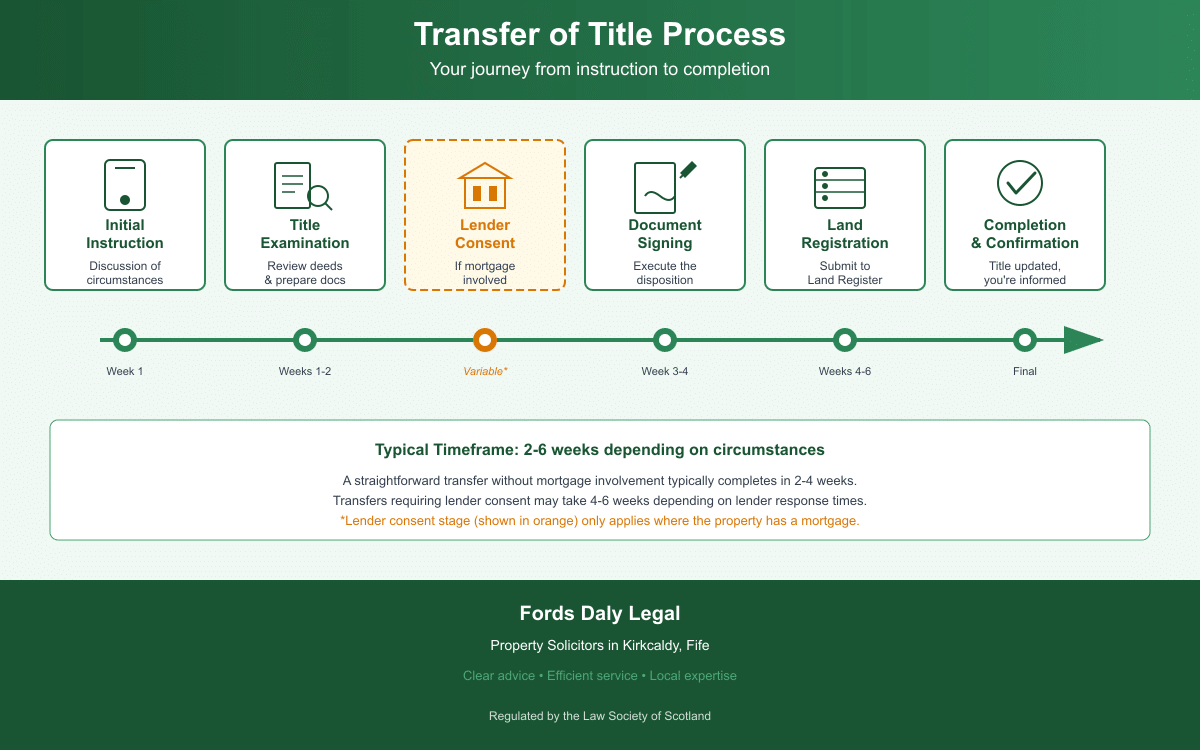
The main stages of the process are:
- Initial instruction and advice: We discuss your circumstances, explain the process, and gather the information we need to proceed.
- Title examination and documentation: We review the existing title and prepare the legal documents needed for the transfer.
- Lender consent (where applicable): If the property has a mortgage, we obtain the necessary consent from your lender. This is often the stage that determines overall timescales.
- Document signing: Once everything is in place, the relevant parties sign the transfer documentation.
- Registration: We submit the transfer to Registers of Scotland to update the Land Register.
- Completion and confirmation: Once registration is complete, you receive confirmation that the transfer is finalised.
We keep you informed throughout and will give you a realistic estimate of timescales based on your specific circumstances.
Transfer of Title Costs
The cost of a transfer of title depends on the complexity of your situation. We provide clear, transparent pricing so you know what to expect before you proceed.
Our fees cover all the legal work involved in the transfer, including title examination, document preparation, lender liaison where applicable, and registration. In addition to our fees, there are disbursements (third-party costs) that you’ll need to pay:
- Land Register fees: Registers of Scotland charges a fee to update the Land Register. The amount depends on the property value.
- Land and Buildings Transaction Tax (LBTT): Depending on the nature of the transfer, LBTT may be payable. Many transfers between family members or following separation are exempt or attract no tax, but this needs to be assessed case by case.
- Lender fees: If your lender needs to consent to the transfer or release a party from the mortgage, they may charge an administration fee.
We’ll provide you with a detailed quote at the outset, setting out our fees and estimated disbursements so there are no surprises.

Why Choose Fords Daly Legal
Clients across Kirkcaldy, Glenrothes, Dunfermline, Leven, and throughout Fife choose Fords Daly Legal for their property transfers because of our straightforward approach and commitment to clear communication.
Experienced property lawyers
Our team has extensive experience in Scottish residential property law, including all types of title transfers. We understand the technical requirements and potential pitfalls.
Local knowledge
Based in Kirkcaldy, we have detailed knowledge of property matters across Fife. We’re familiar with local considerations and can often identify issues that firms from outside the area might miss.
Clear, plain-English advice
We explain the legal process without jargon, ensuring you understand what’s happening at each stage. You won’t be left wondering what comes next.
Proactive communication
We keep you informed of progress and respond promptly to your questions. You’ll have direct access to the solicitor handling your matter.
Attention to detail
We take care to ensure your transfer is completed correctly, avoiding issues that could cause problems in the future.
Regulated by the Law Society of Scotland
As a regulated Scottish law firm, we meet the professional standards required by the Law Society of Scotland, giving you confidence in the service you receive.
Competitive, transparent fees
We provide clear pricing upfront so you know exactly what the transfer will cost.
Whether you’re transferring property following a separation, adding a partner to your title, or making changes for family planning reasons, we’re here to help.
Take the Next Step
If you need to transfer property ownership in Scotland, whether you’re based in Kirkcaldy, Fife, or the surrounding areas, Fords Daly Legal can help. Our experienced team will guide you through the process with clear advice and efficient service.
📞 Call us on 01592 640630 to discuss your re-mortgage plans
✉️ Email us with your enquiry
🏢 Visit us at our Kirkcaldy office for a consultation
The sooner you get in touch, the sooner we can start working on your transfer. Contact us today to take the first step towards updating your property ownership.

Frequently Asked Questions About Transfer of Title in Scotland
What is a transfer of title?
A transfer of title is the legal process of changing who owns a property, either fully or partially, without a traditional sale. It’s commonly used when adding or removing someone from ownership, transferring property between family members, or changing how a property is held. The transfer must be properly documented and registered with the Land Register of Scotland to be legally effective.
Do I need a solicitor for a transfer of title in Scotland?
Yes. In Scotland, a solicitor is required to prepare the legal documents for a property transfer and to register the change of ownership with Registers of Scotland. The process involves examining the existing title, preparing a disposition (the document that transfers ownership), and ensuring the new ownership is correctly recorded. A solicitor ensures this is done properly to avoid future complications.
Can I transfer a property title if there is a mortgage?
Yes, but the lender’s consent is usually required. The lender has a security interest in the property and will need to approve any change in ownership. Depending on your situation, the lender may need to assess the affordability of the remaining owner, agree to release one party from the mortgage, or approve a new person being added to both the title and mortgage. We handle all communications with lenders as part of our service.
Is a transfer of title the same as selling a property?
No. A sale involves a buyer and seller agreeing a purchase price, with money changing hands in exchange for ownership. A transfer of title changes ownership without a conventional sale, often with no payment involved. However, the legal process of transferring ownership and registering the change is similar. Transfers can arise from many circumstances including family arrangements, separation, divorce, or estate planning.
How long does a transfer of title take in Scotland?
Timescales vary depending on the complexity of your situation. A straightforward transfer with no mortgage involvement can often be completed within two to four weeks. If lender consent is required, the process typically takes four to six weeks, though this depends on how quickly the lender responds. We’ll give you a realistic estimate based on your specific circumstances.
Will I have to pay tax on a transfer of title?
It depends on the circumstances. Land and Buildings Transaction Tax (LBTT) may apply to some transfers, particularly where money or other consideration is involved. However, many transfers are exempt from LBTT, including certain transfers between spouses or civil partners and transfers as part of a divorce settlement. We’ll advise on whether LBTT applies to your transfer and handle any necessary submissions to Revenue Scotland.
Can I add my partner to the title of my property?
Yes. Adding a spouse, civil partner, or cohabiting partner to your property title is a common type of transfer. We’ll prepare the necessary documentation to add them as a joint owner and advise on how the property should be held going forward. If there’s a mortgage on the property, your lender will need to approve the change and may require your partner to be added to the mortgage as well.
What happens to the title when a joint owner dies?
When a property is held jointly in Scotland, what happens depends on how the ownership was set up. If the title includes a survivorship destination (as most joint ownership does), the surviving owner automatically becomes sole owner. However, the Land Register still needs to be updated to remove the deceased person’s name and reflect the surviving owner as sole proprietor. We can handle this process for you.
Can I transfer my property to my children?
Yes, you can transfer property to your children, but this requires careful consideration. Such transfers may have inheritance tax implications, could affect your entitlement to certain benefits, and might be relevant if you need local authority care in the future. We can complete the legal transfer, but we’d recommend seeking advice from a tax specialist or financial adviser to understand the full implications before proceeding.
What is a transfer of equity?
A transfer of equity is a specific type of title transfer where ownership changes but a mortgage remains on the property. It’s commonly used when one owner is removed from both the title and the mortgage, such as following separation or divorce. The process requires the lender’s consent and may involve the lender assessing whether the remaining owner can afford the mortgage on their own.
Do both parties need to use the same solicitor?
Not necessarily. In some transfers, such as between spouses making a joint decision, one solicitor can act for both parties. However, in other situations, such as contested separations or where the parties have different interests, each party may need their own independent legal advice. We’ll advise on what’s appropriate for your circumstances.
How much does a transfer of title cost?
The cost depends on the complexity of your transfer. Our fees cover all the legal work involved, and we’ll provide a detailed quote before you proceed. In addition to our fees, you’ll need to pay disbursements including Land Register fees (which depend on property value) and any LBTT that may be due. We explain all costs upfront so there are no surprises.
Related Services
- Selling a House in Scotland – Expert guidance through every stage of the selling process.
- Residential Estate Agency – Marketing your property to find the right buyer at the best price
- Buying a House in Scotland – Comprehensive conveyancing support when purchasing a property.
- Re-mortgaging – Legal support when switching to a new mortgage deal.
- Discharging a Security – Removing a mortgage or other security from your title when the loan is repaid.
- Family Law – If your transfer relates to a separation or divorce, our family law team can assist with the wider legal aspects.